
Washer Savings Calculator
Current Washer
5-Star Washer Target
Annual Savings
$0Reliability Comparison
When you see a washing machine labeled as a 5-star rated washer, it doesn’t just mean it looks nice or has a fancy display. It means it’s been tested, measured, and ranked by real users and independent labs based on how well it actually cleans clothes, saves water and energy, and lasts over time. This isn’t a rating handed out by the brand - it’s earned. And if you’re shopping for a new washer, understanding what goes into that 5-star rating can save you hundreds of dollars and years of frustration.
What Exactly Makes a Washer 5-Star?
A 5-star rating on a washing machine doesn’t come from a single factor. It’s the result of a combination of performance metrics tested under strict conditions. In the U.S., the Energy Star program and the FTC’s Energy Guide label are the main sources, but third-party testers like Consumer Reports and Wirecutter add real-world data. To hit 5 stars, a washer must score high in five key areas: cleaning power, spin efficiency, water usage, energy consumption, and noise levels.
Take cleaning power. A 5-star washer doesn’t just remove dirt - it removes tough stains like grease, mud, and sweat without pre-soaking or extra cycles. In Consumer Reports’ tests, they use standardized soiled swatches - think grass stains on cotton, oil on polyester - and measure how much residue remains after one wash. Machines that leave less than 5% residue across all fabric types get top marks.
Spin efficiency matters too. A good 5-star washer extracts more water during the spin cycle. That means clothes come out less wet, so your dryer doesn’t have to work as hard. This cuts drying time by up to 30%, which saves energy and reduces wear on your clothes. Models that spin at 1,200 RPM or higher, and still stay balanced, are the ones that earn full points here.
Water and Energy Savings Are Non-Negotiable
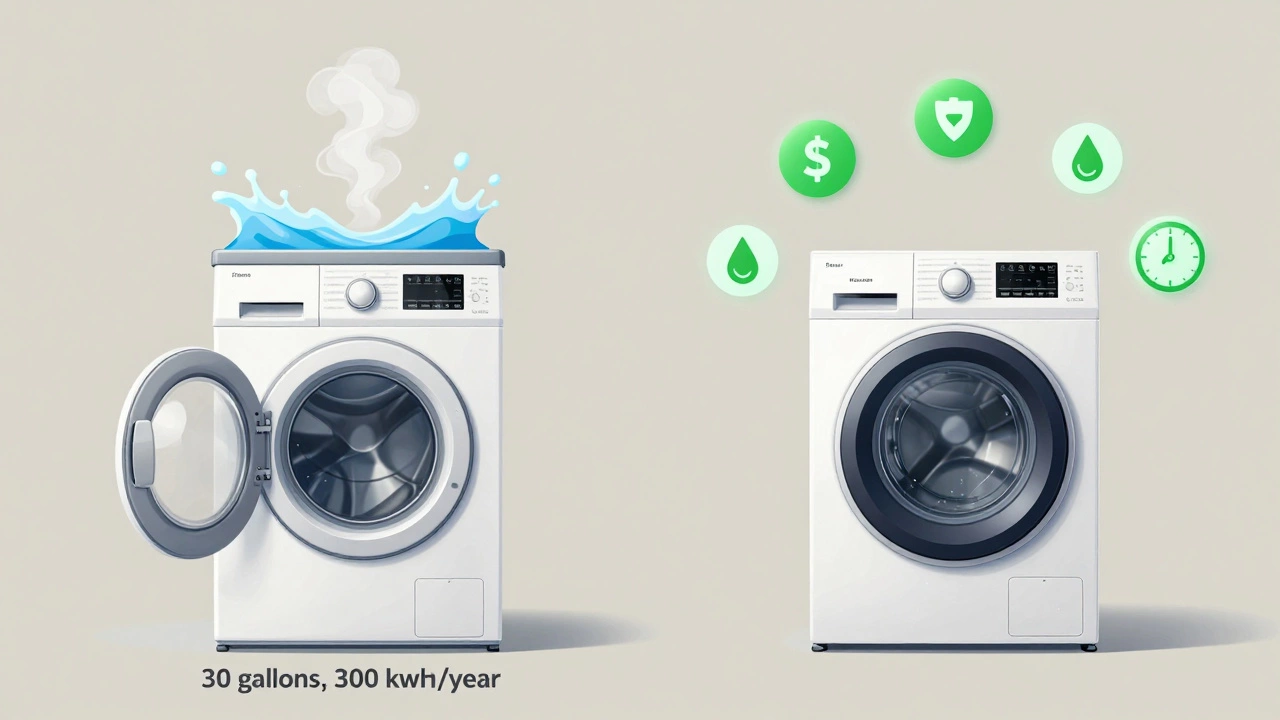
Most people don’t realize that washing machines are the second-largest water users in the home, after showers. A 5-star rated washer uses no more than 13 gallons per load on average - sometimes as low as 9 gallons - compared to older models that gulp 30 to 40 gallons. That’s not just good for the planet; it’s good for your water bill. The Energy Star program requires these machines to use at least 25% less energy and 33% less water than standard models.
Electricity use is measured in kilowatt-hours per year. A top-rated washer uses around 100 kWh/year, while older top-loaders can hit 300 kWh. That’s a $25 to $50 annual savings per machine. Over a 10-year lifespan, that’s $500 in energy savings alone - and that’s before you factor in water savings.
Noise Isn’t Just About Comfort - It’s About Design
A 5-star washer doesn’t sound like a jet engine starting up. In fact, many top-rated models run at 55 decibels or lower during the spin cycle - about the level of normal conversation. That’s possible because of advanced engineering: direct-drive motors, better suspension systems, and smart balancing algorithms that adjust the drum’s rotation in real time.
Why does this matter? If you have your washer in a laundry room next to your bedroom, kitchen, or home office, noise becomes a daily annoyance. A noisy machine forces you to run loads at odd hours, or worse - you avoid doing laundry altogether. High-rated washers solve that. Brands like LG and Samsung use inverter direct-drive motors that eliminate belts and pulleys, which are common sources of vibration and noise.
Real-World Durability: The Hidden Star
Here’s what most reviews don’t tell you: a 5-star rating also reflects long-term reliability. Consumer Reports tracks thousands of owners over several years and asks: Did the machine break down? Did it need repairs? Did it keep performing well after 5 years?
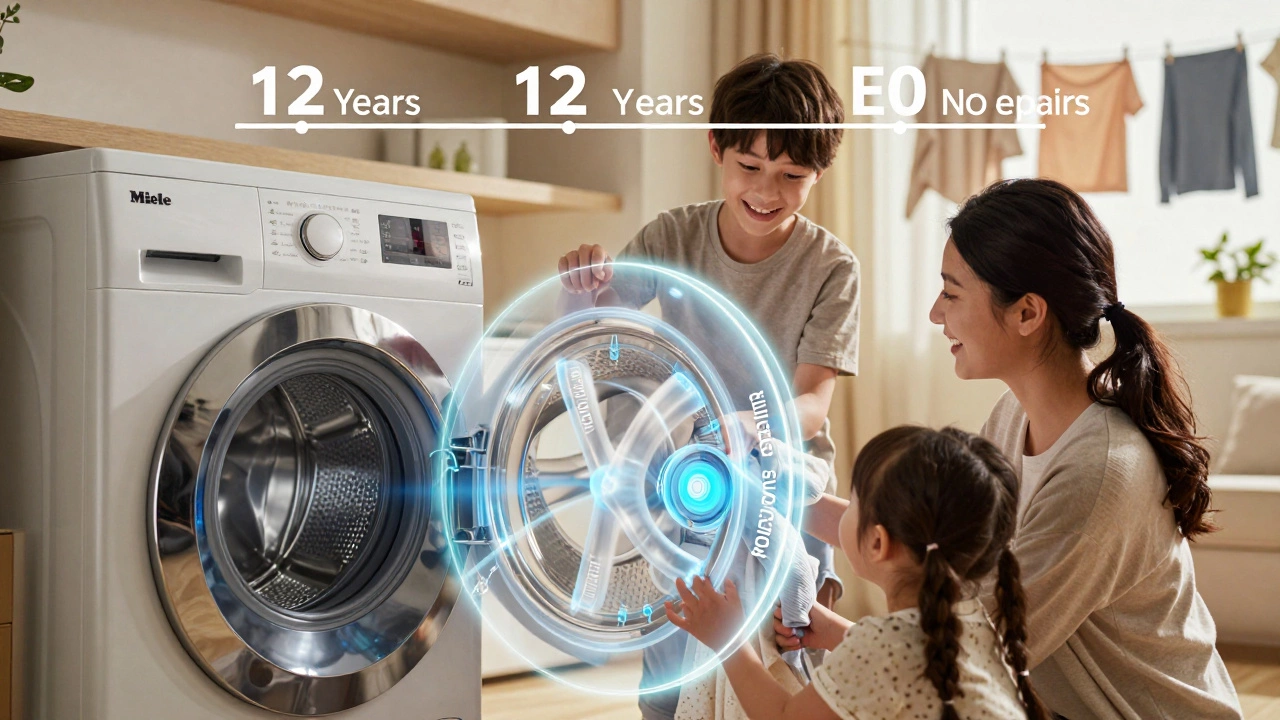
Top-rated washers have failure rates below 10% after five years. That’s half the rate of budget models. Brands like Miele, Whirlpool, and LG consistently rank high because they use stainless steel drums, sealed bearings, and high-quality electronics. Cheaper models often use plastic drums or rubber belts that crack or wear out fast. A $600 washer that breaks in three years costs more than a $900 one that lasts ten.
What to Look for When You’re Shopping
Don’t just trust the label. Go beyond the star rating and check these specifics:
- Capacity: Look for 4.5 to 5.3 cubic feet for families. Smaller households can get by with 3.8 to 4.3.
- Spin speed: Aim for 1,200 RPM or higher.
- Water factor: The lower the number (on the Energy Guide label), the better. Under 3.5 is excellent.
- Wash cycles: A 5-star washer should have at least one dedicated cycle for heavy-duty stains and one for delicates.
- Smart features: Wi-Fi connectivity is nice, but not essential. Focus on performance first.
Also, read owner reviews on sites like Amazon or Home Depot. Look for patterns: if 10% of users mention mold buildup or loud spinning, that’s a red flag. Top-rated machines rarely have recurring complaints.
Top 5-Star Washers in 2026
Here are three models that consistently earn 5-star ratings across multiple testing platforms:
- LG WM4000HWA: 4.5 cu. ft., 1,200 RPM, uses 9.5 gallons per load, whisper-quiet, 9% failure rate after 5 years.
- Whirlpool WTW5000DW: 4.3 cu. ft., 1,100 RPM, Energy Star certified, excellent stain removal, priced under $800.
- Miele W1: 4.0 cu. ft., 1,400 RPM, German engineering, 5-year warranty, 3% failure rate - the most reliable on the market.
These aren’t the most expensive models, but they’re the ones that deliver on every promise. Skip the flashy screens and voice control. Focus on the numbers that matter: gallons per load, RPM, and repair history.
Why a 5-Star Washer Is Worth the Investment
Let’s say you buy a 5-star washer for $900. You save $40 a year on energy and water. In 22 years, you’ve paid for the machine - and you still have a working washer. Meanwhile, a $500 budget model might save you upfront, but it’ll likely need repairs by year 4 and die by year 7. You’ll end up buying two machines in the same time span - and paying more in utility bills the whole time.
Plus, your clothes last longer. High-efficiency washers use less water and gentler agitation, which reduces fabric wear. You won’t need to replace your towels, jeans, or workout gear as often. That’s real value.
Common Misconceptions
Some people think more features = better performance. That’s not true. A washer with 15 cycles, a steam option, and a built-in detergent dispenser isn’t necessarily cleaner. In fact, extra features often mean more things that can break.
Others believe front-loaders are always better. While most 5-star washers are front-loaders, there are high-efficiency top-loaders now that match their performance - like the Whirlpool model above. The key is the rating, not the design.
And no, a higher price doesn’t guarantee a 5-star rating. Some $1,200 machines have worse spin efficiency or higher water use than mid-range models. Always check the data, not the sticker price.
Final Tip: Don’t Buy Based on Sales
Black Friday deals on washing machines are tempting, but the cheapest option is rarely the best. Wait for the new Energy Guide labels to update each January - that’s when the latest 5-star models are officially certified. If you’re shopping in early 2026, the top-rated machines are already out. Don’t settle for last year’s model just because it’s on sale.
Buy once. Buy right. A 5-star rated washer isn’t a luxury - it’s the smartest appliance purchase you’ll make this year.
Is a 5-star rated washer always a front-loader?
No. While most top-rated washers are front-loaders due to their water and energy efficiency, high-efficiency top-loaders like the Whirlpool WTW5000DW now match or exceed front-loader performance. The key is the rating, not the design. Look for Energy Star certification and low water factor numbers, regardless of loading type.
Do 5-star washers clean better than regular ones?
Yes, significantly. Independent tests show that 5-star rated washers remove up to 40% more stains than standard models without pre-treatment. They use precise water levels, optimized drum motion, and advanced detergent dispensing to target dirt more effectively. This means fewer rewashes and less wear on your clothes.
Can I trust Energy Star ratings?
Yes. Energy Star is a U.S. government-backed program that tests appliances under controlled, repeatable conditions. Machines must meet strict thresholds for energy and water use to qualify. But for real-world performance, combine Energy Star with reviews from Consumer Reports or Wirecutter, which test cleaning power and reliability over time.
Why are 5-star washers more expensive?
They use better materials - stainless steel drums, direct-drive motors, sealed bearings - and advanced engineering to reduce noise, water use, and energy consumption. The higher upfront cost pays for itself in lower utility bills and fewer repairs. A $900 washer that lasts 12 years costs less per year than a $500 one that breaks in 5.
Do I need a smart washer to get a 5-star rating?
No. Smart features like Wi-Fi and app control don’t improve cleaning or efficiency. Many 5-star washers have no smart capabilities at all. Focus on performance metrics: gallons per load, spin speed, energy use, and repair history. Save money on apps and spend it on durability.