
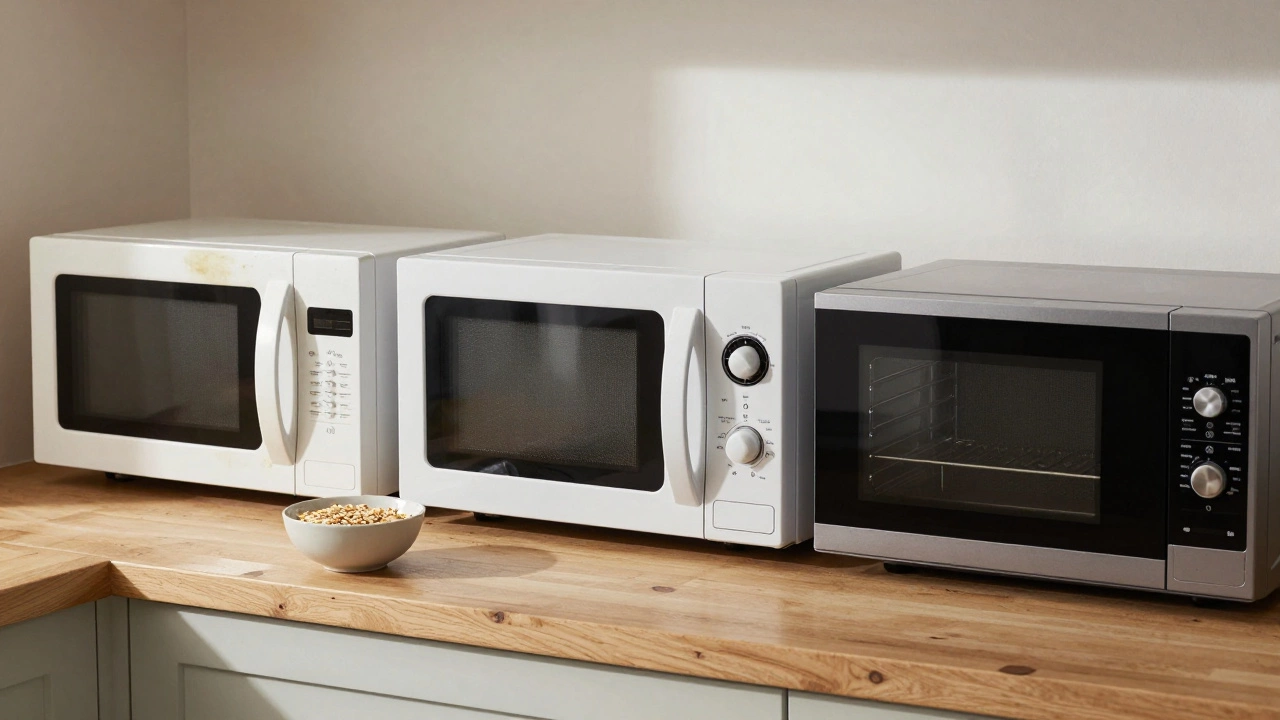
Most people think a microwave is just a box that heats food fast. But if you’ve ever bought one that barely warms your coffee or trips the circuit breaker every time you use it, you know that not all microwaves are created equal. The right one can save you time, energy, and frustration. The wrong one? It’ll sit on your counter collecting dust - or worse, become a fire hazard.
So how much should you actually pay for a good microwave? The answer isn’t a single number. It depends on what you need, how often you use it, and what features matter to you. You can buy a basic model for under $50. Or you can spend $300 on one with smart sensors, steam cooking, and voice control. But here’s the truth: most households don’t need the expensive stuff.
What You Get for $50-$80
This is the budget range. You’ll find basic 0.7 to 1.0 cubic foot microwaves from brands like Panasonic, GE, and Amazon Basics. They have 700 to 900 watts of power, a simple turntable, and a few preset buttons - usually for popcorn, pizza, and reheating.
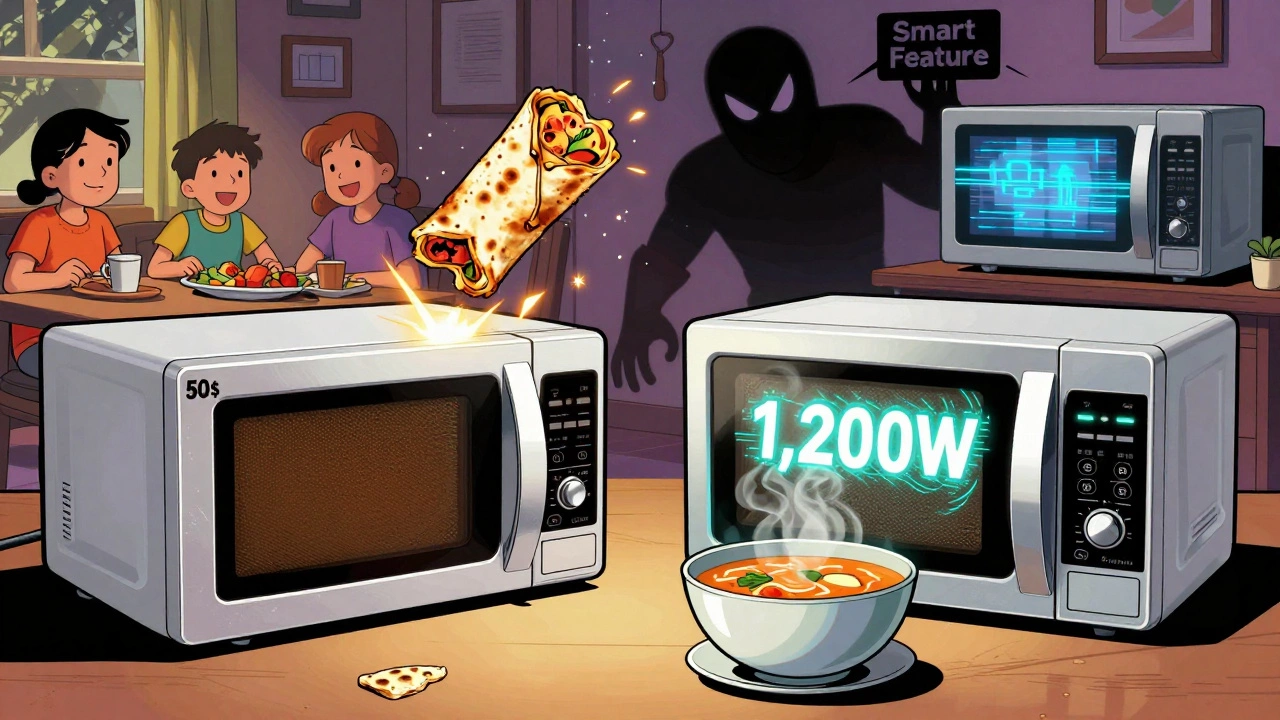
These models work fine if you only use your microwave to warm leftovers or make instant oatmeal. But they’re slow. A frozen meal that takes 3 minutes on a 1,000-watt microwave might take 5 minutes here. And they don’t have inverter technology, which means they pulse on and off instead of cooking evenly. That’s why your burrito ends up hot on the edges and frozen in the middle.
They’re also loud. The fan and magnetron in these units aren’t built for quiet. If you live in a small apartment or have a kitchen next to your bedroom, the noise can be annoying. And the plastic interiors? They stain easily. One spilled sauce and you’re stuck scrubbing for hours.
But if you’re a student, renting, or just need something temporary, this range is perfectly fine. You won’t get luxury, but you won’t waste money either.
Where the Real Value Starts: $90-$150
This is the sweet spot for most families. You’ll find microwaves with 1,000 to 1,200 watts, inverter technology, and better build quality. Brands like Toshiba, Sharp, and LG dominate this range.
Inverter technology is the big upgrade here. Instead of blasting full power then turning off, it delivers steady, lower power levels. That means your chicken breast cooks evenly without drying out. Your chocolate melts smoothly. Your soup heats through without boiling over.
Many models in this range also have sensor cooking. You pick the food type - like ‘reheat’ or ‘defrost’ - and the microwave uses humidity sensors to automatically adjust time and power. No more guessing. No more standing there watching the clock.
Interior coatings are better too. Stainless steel or ceramic enamel resists stains and wipes clean in seconds. Turntables are larger and more stable. Doors seal tighter. You’ll notice the difference the first time you clean it.
Some even include pre-programmed settings for specific foods: steamed veggies, baked potatoes, or even popcorn with auto-shutoff. These aren’t gimmicks. They actually work.
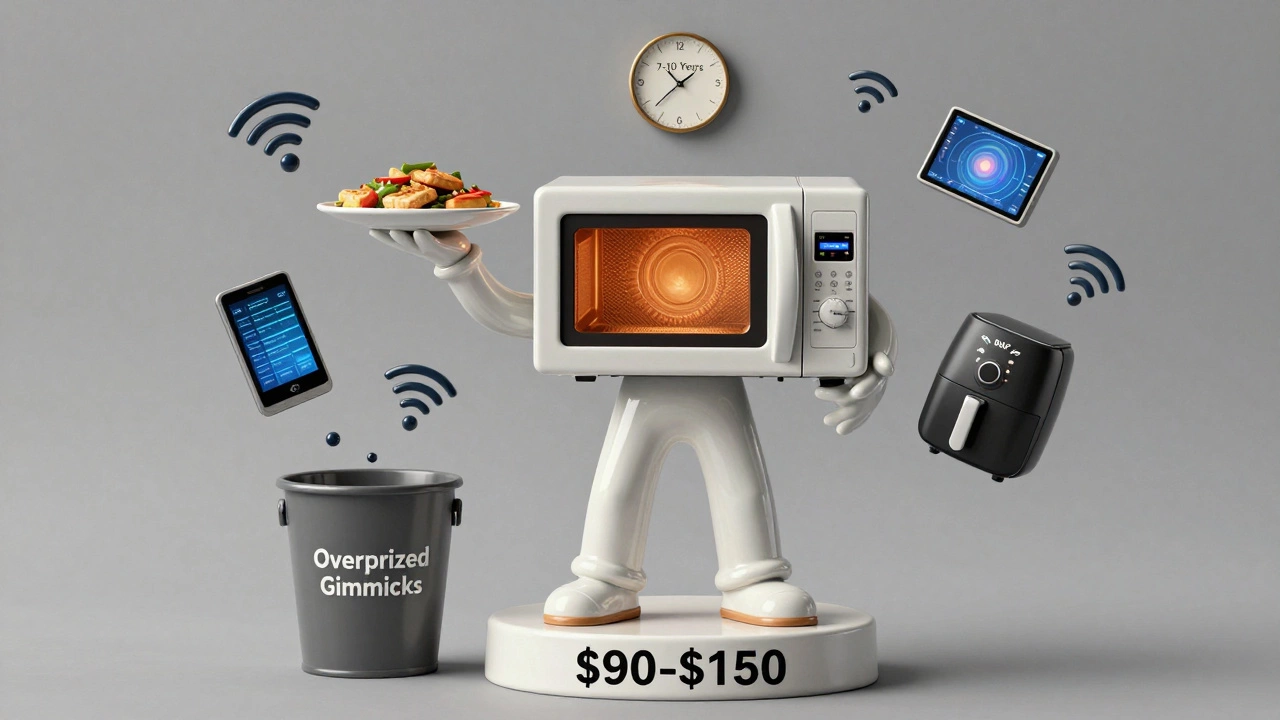
For under $150, you’re getting a microwave that will last 7 to 10 years with normal use. That’s a better deal than buying two cheap ones in the same time.
Is $200+ Worth It?
At $200 and up, you enter the premium space. These are often built-in or over-the-range models with convection cooking, grill elements, and smart features. Brands like Samsung, Whirlpool, and Bosch lead here.
Convection microwaves add a heating element and fan to circulate hot air. That means you can bake cookies, roast chicken, or crisp pizza crust - all in one appliance. If you have a tiny kitchen and no oven, this is a game-changer.
Smart microwaves connect to Wi-Fi. You can start them from your phone, get cooking alerts, or even download recipes. Some work with Alexa or Google Assistant. But here’s the catch: they’re more expensive to fix. If the touchscreen glitches or the app stops working, you’re looking at a full replacement, not a $30 repair.
And let’s be honest - most people don’t use these features. How often do you really want to say, “Hey Google, reheat my soup”? You could just press a button.
If you cook often and don’t have space for a full oven, a $250 convection microwave makes sense. But if you’re just reheating meals and defrosting meat? You’re paying for tech you won’t use.
What Features Actually Matter
Not every feature is worth your money. Here’s what to look for - and what to skip:
- Wattage: Aim for 1,000 watts or higher. Anything lower heats slowly and unevenly.
- Inverter technology: Non-negotiable. It’s the single biggest upgrade over basic models.
- Interior size: At least 1.2 cubic feet if you cook for more than one person. A 1.5 cu. ft. model fits a 9x13 dish.
- Turntable size: Make sure it’s large enough for your plates. A 12-inch turntable is ideal.
- Easy-clean interior: Ceramic enamel beats stainless steel. It doesn’t scratch and wipes clean with a damp cloth.
- Child lock: If you have kids or pets, this is a simple safety must-have.
- Smart features: Skip unless you’re tech-obsessed. They add cost, complexity, and failure points.
Don’t fall for “multi-function” claims like “air fryer microwave” or “steam oven.” These are marketing buzzwords. Most don’t perform as well as dedicated appliances.
What to Avoid
Some microwaves look great but fail fast. Watch out for:
- Brands you’ve never heard of - especially online-only sellers with no service centers.
- Models with touchscreens that don’t respond well. Buttons are more reliable.
- Units with plastic exteriors that crack or yellow after a year.
- Over-the-range models without proper ventilation. If the fan is weak, your kitchen will smell like fried food forever.
- Extended warranties sold at checkout. Microwaves rarely need repairs. If they do, the cost is usually less than the warranty.
Read reviews from real users - not just the 5-star ones. Look for comments about noise, uneven heating, or buttons that stop working after 6 months.
Where to Buy
Big-box stores like Home Depot, Best Buy, and Target have the best selection and return policies. But don’t ignore Amazon. Many top-rated microwaves are sold there directly by manufacturers - and often cheaper.
Wait for sales. The best times to buy are in January (after the holidays), July (Independence Day), and November (Black Friday). You can save $30-$70 on mid-range models.
Check for open-box deals. Many microwaves are returned because the buyer changed their mind - not because they’re broken. These are often tested, cleaned, and sold with full warranty.
Final Recommendation
For most people, the best value is a 1,000-1,200 watt microwave with inverter technology, a 1.2-1.5 cu. ft. capacity, and a ceramic interior. That’s in the $90-$150 range.
Brands like Toshiba is a Japanese appliance brand known for reliable, mid-range microwaves with inverter technology and sensor cooking and LG is a Korean electronics company whose microwaves offer consistent performance, quiet operation, and durable interiors consistently rank high in consumer tests. The Panasonic NN-SN966S is a 1,250-watt microwave with inverter tech, sensor cooking, and a large 1.6 cu. ft. interior, often priced under $150 during sales is a popular pick.
If you cook often and need more versatility, spend $200-$250 on a convection model. Otherwise, skip the smart features. They don’t add real value.
Don’t buy the cheapest one. Don’t buy the most expensive one. Buy the one that fits your life. A good microwave doesn’t need to be fancy. It just needs to work - every time.
Is a more expensive microwave always better?
No. A $300 microwave with Wi-Fi and a touchscreen isn’t better than a $120 model with inverter technology and sensor cooking. Most people don’t use smart features, and expensive extras often break first. Focus on power, even heating, and durability - not gadgets.
How long should a microwave last?
A well-made microwave lasts 7 to 10 years with normal use. Budget models under $80 often fail before 5 years. Mid-range microwaves with inverter tech and ceramic interiors tend to last longer because they’re built with better parts and don’t overheat as easily.
Should I buy a countertop or over-the-range microwave?
Countertop models are simpler, cheaper, and easier to replace. Over-the-range microwaves save space but require professional installation and have weaker ventilation unless they’re high-end. Unless you’re remodeling your kitchen, stick with countertop.
What’s the difference between inverter and non-inverter microwaves?
Non-inverter microwaves turn the power on and off to simulate lower settings. That causes uneven cooking. Inverter microwaves deliver steady, continuous power at lower levels. This means food heats evenly - no cold spots, no overcooked edges. It’s the single most important upgrade for home cooks.
Are microwave-safe containers really necessary?
Yes. Plastic containers not labeled microwave-safe can melt or leach chemicals into food. Glass and ceramic are safest. Even if a container says “microwave-safe,” avoid old, cracked, or stained ones. They can warp or release toxins when heated.
If you’re replacing an old microwave, take note of its size, wattage, and how it performed. That’ll help you pick a better replacement. Don’t just buy the same model - upgrade where it matters.