
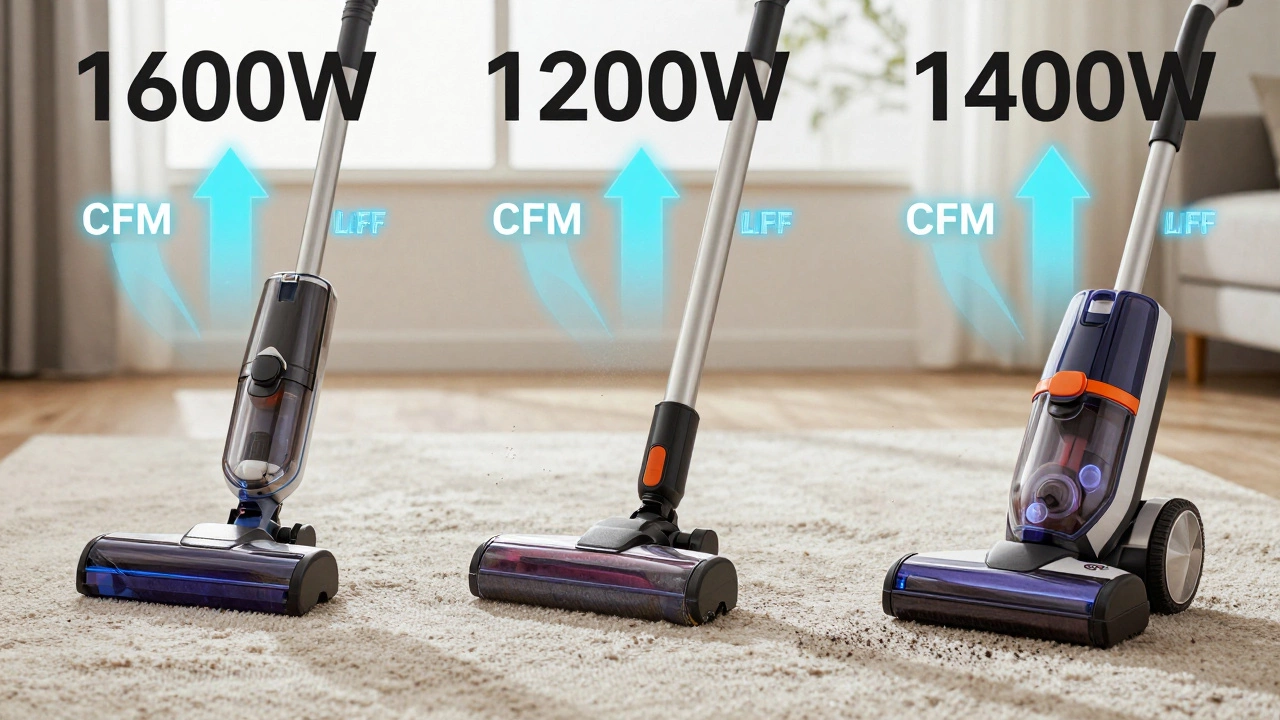
You’ve seen it on every vacuum cleaner box: 1200 watts. 1500 watts. Even 2000 watts. It sounds impressive, right? Like more watts must mean a machine that pulls dirt out of your carpet like a tornado. But here’s the truth-higher wattage doesn’t automatically mean better suction. In fact, it’s one of the biggest marketing tricks in the vacuum cleaner industry.
What wattage actually measures
Wattage tells you how much electricity the vacuum uses, not how hard it pulls. Think of it like your car’s fuel consumption. A truck might burn more gas than a sedan, but that doesn’t mean it drives faster. Same thing here. A 1600-watt vacuum could be a total energy hog with weak suction if its motor, airflow design, or filters are poorly built.
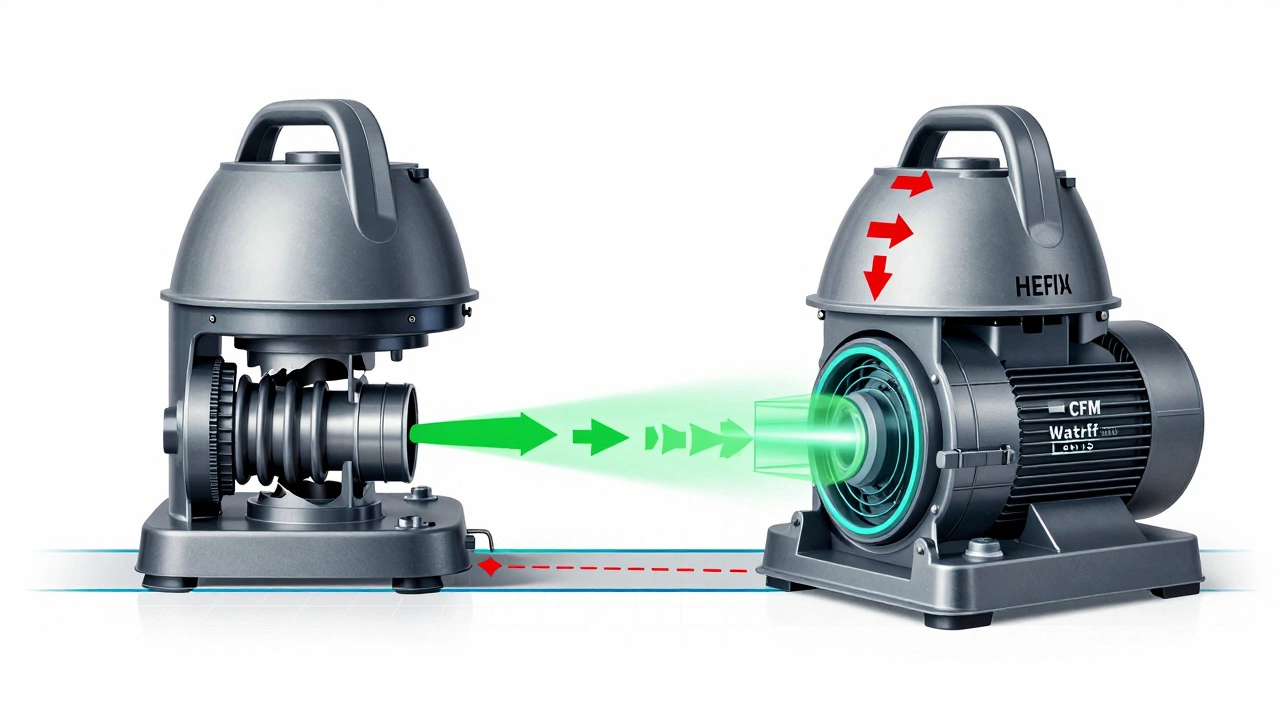
Real suction power comes from two things: airflow (measured in cubic feet per minute, or CFM) and vacuum pressure (measured in inches of water lift). These are what actually lift dirt off your floor and move it into the bag or bin. A vacuum with 100 CFM and 80 inches of water lift will clean better than one with 1800 watts but only 60 CFM and 50 inches of water lift.
Manufacturers know most people don’t know the difference. So they put big wattage numbers front and center. You walk into a store, see ‘2000W’ on the box, and assume it’s the strongest. It’s not. It’s just using more power-and probably costing you more on your electricity bill.
Why some high-wattage vacuums still suck
Let’s say you buy a vacuum advertised as 1800 watts. It feels heavy, sounds loud, and the cord is thicker than your arm. You expect it to suck up pet hair like magic. But after a few passes, your rug still looks dusty. Why?
Chances are, the airflow is restricted. Maybe the hose is kinked. Maybe the filter is clogged. Maybe the brush roll is jammed. Or worse-the design just doesn’t move air efficiently. A poorly sealed system leaks suction. A cheap motor spins fast but doesn’t create strong pressure. Even with high wattage, if the air can’t flow smoothly from the floor to the dustbin, you’re just spinning a motor for nothing.
There’s a reason professional cleaners use commercial vacuums like the Nilfisk or Numatic Henry. They don’t always have the highest wattage ratings. But they have sealed systems, large filters, and motors tuned for airflow. They clean better with 1200 watts than some 1800-watt home models.
What actually matters for suction
If wattage is misleading, what should you look for instead?
- Airflow (CFM): Higher is better. Look for models that list this number. Anything above 80 CFM is solid for home use.
- Water lift: This measures suction strength. 80+ inches is good for carpets; 100+ is excellent for deep cleaning.
- Sealed system: If air escapes anywhere between the floorhead and the motor, suction drops. Check if the manufacturer claims a ‘sealed HEPA system’-that’s a good sign.
- Brush roll design: A motorized brush that spins at the right speed helps lift dirt from fibers. A weak brush roll won’t help even the strongest suction.
- Filter quality: A clogged filter kills suction. Washable, high-capacity filters last longer and keep performance steady.
Some brands like Dyson, Miele, and Shark now list airflow and water lift right on their packaging. That’s a good sign they’re not hiding behind wattage. If you can’t find those numbers, assume they’re not confident in them.
Real-world test: wattage vs performance
Here’s what happened when a Vancouver homeowner tested three vacuums on the same carpet with the same amount of pet hair and fine dust:
| Model | Advertised Wattage | Airflow (CFM) | Water Lift (inches) | Cleaning Score (out of 10) |
|---|---|---|---|---|
| Brand X (Budget Model) | 1600W | 55 | 45 | 4.2 |
| Brand Y (Mid-Range) | 1200W | 92 | 88 | 8.9 |
| Brand Z (Premium) | 1400W | 105 | 102 | 9.6 |
The 1600-watt model was the worst performer. The 1200-watt model cleaned better than half the vacuums tested. The 1400-watt model was the top performer-not because of wattage, but because of airflow and sealing.
Wattage didn’t predict performance. Airflow and pressure did.
Energy efficiency matters too
Higher wattage means higher electricity bills. A 1600-watt vacuum running for 30 minutes uses 0.8 kilowatt-hours. A 1000-watt model doing the same job uses only 0.5 kWh. Over a year, that’s dozens of dollars saved-especially if you clean often.
Many countries now require vacuums to meet energy efficiency standards. In the EU, the max allowed wattage for home vacuums is 900W (as of 2017). The U.S. doesn’t have a cap, but the most efficient models today are under 1200W. That’s not a coincidence. Better engineering doesn’t need brute force.
If you’re looking to cut energy use and clean better, skip the high-wattage models. Go for ones that focus on airflow and sealed systems instead.
What to do before you buy
Don’t let wattage fool you. Here’s your quick checklist before buying a vacuum:
- Look for airflow (CFM) and water lift numbers-ignore wattage unless it’s under 1000W.
- Check if the vacuum has a sealed system. If it doesn’t say so, assume it leaks.
- Read reviews that test suction on carpets and hard floors, not just marketing claims.
- Watch YouTube videos showing real cleaning tests-especially with pet hair and fine dust.
- Consider weight and maneuverability. A heavy vacuum with great suction is useless if you hate using it.
Some of the best vacuums on the market today-like the Miele Complete C3 or the Shark Vertex Pro-use under 1200 watts. They clean better than most 1800W models because they’re engineered for efficiency, not just power.
Bottom line
Higher wattage doesn’t mean better suction. It just means higher electricity use. Real suction comes from airflow, pressure, and a well-designed system. If you want a vacuum that actually cleans, stop looking at the wattage label. Look at the numbers that matter-and listen to real users, not the ad copy.
Choose performance over power. Your floors-and your electric bill-will thank you.
Does a 2000-watt vacuum clean better than a 1200-watt one?
Not necessarily. A 2000-watt vacuum may use more electricity, but if its airflow is low or its system leaks air, it won’t clean better. Many 1200-watt models with high CFM and water lift outperform them. Always check airflow (CFM) and suction pressure (water lift) instead of wattage.
Why do manufacturers advertise high wattage if it doesn’t matter?
Because most consumers don’t know what actually affects suction. Wattage is an easy number to understand and makes a product look powerful. It’s a marketing tactic. Companies know people associate higher numbers with better performance, even when it’s misleading. Look past the wattage and find specs that matter-like airflow and sealed systems.
What’s the ideal wattage for a home vacuum?
There’s no ideal wattage-it’s not the right metric. Instead, aim for at least 80 CFM airflow and 80+ inches of water lift. Most effective home vacuums today use between 800W and 1200W. Anything above 1400W is usually unnecessary and less energy efficient.
Can I improve suction on my current vacuum?
Yes. Clean or replace the filter, check for clogs in the hose or brush roll, ensure all connections are sealed, and empty the bin before each use. A clogged filter or blocked hose can cut suction by 50% or more, no matter the wattage.
Do cordless vacuums have enough suction?
Many modern cordless vacuums, like the Dyson V15 or LG CordZero, have suction power equal to or better than corded models, even with lower wattage. They use advanced digital motors and optimized airflow paths. Don’t assume cordless means weak suction-check the CFM and water lift specs instead.