
Robot Vacuum Energy Cost Calculator
Your Vacuum Settings
Energy Impact
Your Energy Savings
Your robot vacuum uses 2.25 kWh per month.
That's approximately $0.29 per month at current rates.
This equals about 1 coffee per month.
Compared to traditional vacuums:
Vacuuming 2x/week for 30 minutes uses 4.3 kWh/month.
That's $0.56 per month.
Robot vacuums are everywhere now-dodging couch legs, climbing carpets, and cleaning while you sleep. But if you’ve ever wondered whether leaving one running every day is secretly hiking up your electricity bill, you’re not alone. The truth? Most robot vacuums don’t use much power at all. In fact, they’re often more efficient than your old upright vacuum.
How Much Power Does a Robot Vacuum Actually Use?
Most robot vacuums draw between 30 and 60 watts while cleaning. That’s less than a standard LED light bulb. For comparison, a traditional upright vacuum uses 800 to 1,500 watts. Even a hair dryer pulls 1,200 to 1,800 watts. Robot vacuums are built for low-power, long-duration cleaning, not brute-force suction.
Let’s break it down with real numbers. Say your robot vacuum runs for 90 minutes per day at 50 watts. That’s 0.075 kWh per day. Over a month, that’s about 2.25 kWh. At the average Canadian electricity rate of $0.13 per kWh (Vancouver Hydro rates as of 2026), you’re spending roughly 29 cents a month to run it. That’s less than the cost of a coffee.
Some models, like the Roborock S8 Pro Ultra or the iRobot j7+, use even less-around 25 to 40 watts during cleaning. Others with stronger suction or larger brushes might hit 70 watts, but even then, the total monthly cost stays under 50 cents.
What About Charging? Is That a Hidden Cost?
You might think the charging base is sipping electricity all day. It’s not. When the robot is docked and fully charged, the base draws almost nothing-usually less than 0.5 watts. That’s the same as a digital clock. The vacuum only pulls power when it’s actively charging, and most models finish charging in 2 to 4 hours.
Even if your robot charges every day for 3 hours at 40 watts, that’s just 0.12 kWh per day. Over a month, that’s 3.6 kWh. Add that to cleaning usage, and you’re still under 6 kWh total. That’s less than what your phone charger uses in a year.
How Does It Compare to Other Cleaning Methods?
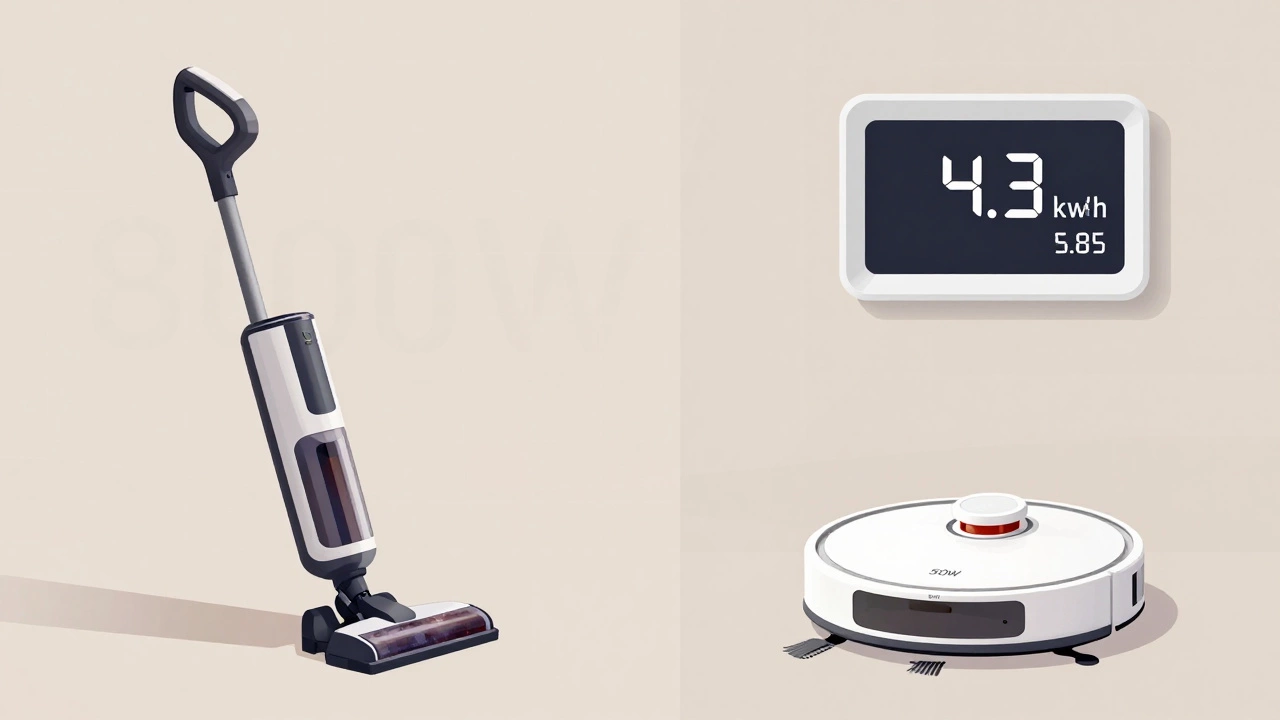
Let’s say you manually vacuum twice a week for 30 minutes each time with a 1,000-watt upright. That’s 1,000 watts × 1 hour per week = 1 kWh per week, or 4.3 kWh per month. Now compare that to the robot vacuum: 2.25 kWh (cleaning) + 3.6 kWh (charging) = 5.85 kWh. Still close, but here’s the catch: the robot cleans daily, so you’re getting more thorough cleaning without lifting a finger.
But if you only vacuum once a week, the robot wins by a mile. And if you use a cordless stick vacuum that runs for 20 minutes per session, three times a week, you’re using about 150 watts × 1 hour = 1.5 kWh per month. The robot still beats it in total energy use while doing more work.
Do Features Like Mapping or Self-Emptying Increase Power Use?
Yes, but not dramatically. Models with LiDAR mapping, multi-floor memory, or self-emptying bases do use a bit more power-but it’s still minimal. The laser scanner uses about 2 watts. The motor that empties the dustbin into a bagged station draws 50 to 80 watts, but only for 30 to 60 seconds per cycle. If you empty the bin once a week, that’s less than 0.01 kWh extra per month.
Even the most advanced models, like the Ecovacs Deebot X2 Omni, which combines cleaning, mopping, auto-emptying, and auto-cleaning brushes, still only add about 10% to the total energy cost. That’s still less than 5 cents a month extra.
What About Sleep Mode and Scheduling?
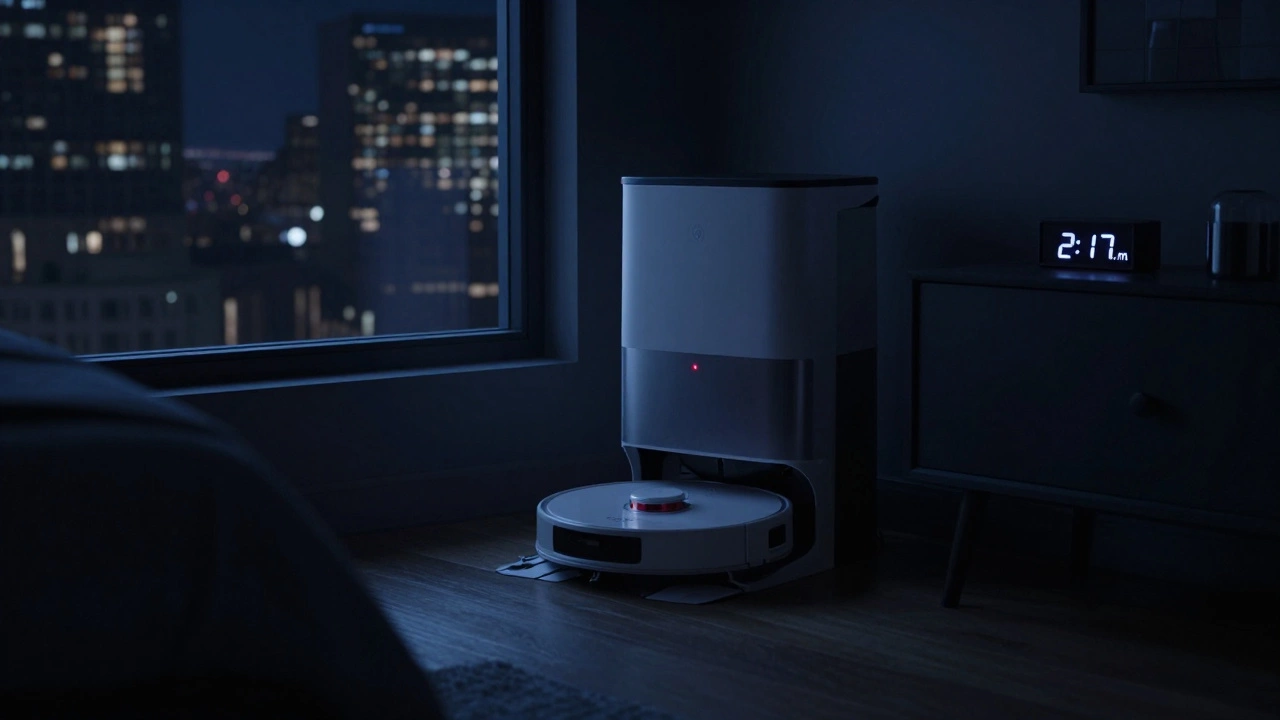
Scheduling your robot to clean while you’re at work or asleep doesn’t increase energy use-it helps reduce it. Running it during off-peak hours (if your utility offers time-of-use rates) can save you money. In some parts of Canada, electricity is 30% cheaper overnight. A robot vacuum that runs at 2 a.m. could cost half as much as one that runs at 6 p.m.
Also, many models have smart sensors that adjust suction power based on floor type. On hard floors, they drop to 20 watts. On thick carpets, they ramp up to 60. This intelligent adjustment means they’re not wasting energy on unnecessary power.
Do Robot Vacuums Save Energy Overall?
Think of it this way: if you used a traditional vacuum for 10 minutes every day, you’d be using 1,000 watts × 10 minutes = 0.167 kWh per day. That’s 5 kWh per month. Your robot vacuum? Around 6 kWh total-including charging and cleaning. But here’s the kicker: your robot cleans 7 days a week, while you probably don’t vacuum more than 2 or 3 times a week. So you’re getting more cleaning for slightly more energy.
And if you’ve got pets, kids, or allergies? The daily cleaning from a robot vacuum reduces dust buildup, which means your air purifier or HVAC system doesn’t have to work as hard. That’s indirect energy savings you don’t even see on your bill.
How to Minimize Power Use Even More
If you’re trying to cut every bit of energy waste:
- Choose a model with a low-wattage motor (under 50 watts during cleaning).
- Turn off the auto-emptying feature if you don’t need it daily.
- Use scheduling to avoid peak electricity hours.
- Keep brushes and filters clean-clogged filters make the motor work harder.
- Opt for models with smart mapping so they don’t clean the same spot twice.
Some newer models, like the Xiaomi Mi Robot Vacuum-Mop Pro, even let you set a maximum cleaning time per session. If your home is small, you can cap it at 45 minutes and save even more.
Bottom Line: It’s Not a Power Hog
Robot vacuums don’t use a lot of electricity. They’re designed to be efficient, quiet, and low-impact. You’re not going to see a spike in your bill from running one daily. In fact, if you’re replacing manual vacuuming, you might be using less energy overall.
The real value isn’t in saving pennies on your electric bill-it’s in the time you get back. That extra hour every week? That’s worth more than the cost of running the robot for a year.
Do robot vacuums use more electricity than regular vacuums?
No. A typical robot vacuum uses 30-60 watts while cleaning, while a regular upright vacuum uses 800-1,500 watts. Even if you run a robot vacuum daily, its total monthly energy use is still lower than running a traditional vacuum twice a week.
Is it cheaper to run a robot vacuum or a cordless stick vacuum?
It depends on usage. A cordless stick vacuum uses about 150 watts and runs for 15-25 minutes per charge. If you use it three times a week, you’ll use about 1.5 kWh per month. A robot vacuum running daily uses 5-6 kWh total (cleaning + charging). So the stick vacuum uses less energy-but the robot cleans more often and more thoroughly.
Does charging the robot vacuum all day waste electricity?
No. Once fully charged, the charging base draws less than 0.5 watts-barely any power. The vacuum only pulls electricity during the 2-4 hours it’s actively charging. After that, it’s essentially idle.
Do self-emptying robot vacuums use a lot of extra power?
Not significantly. The auto-empty function uses 50-80 watts, but only for 30-60 seconds each time it empties. If it empties once a week, that adds less than 0.01 kWh per month-about half a cent.
Can I save money by running my robot vacuum at night?
Yes, if your utility offers time-of-use rates. In Vancouver and other parts of BC, electricity can be 20-30% cheaper overnight. Scheduling your robot to clean between 10 p.m. and 6 a.m. can reduce its operating cost by nearly a third.