
Refrigerator Upgrade ROI Calculator
Your Setup
Financial Analysis
Verdict:
Calculate to see
Enter your details to generate a recommendation.
That monthly electricity bill has a way of creeping up without warning. You check the meter, and there it is: a spike you can’t quite explain. For many households, the culprit isn’t the new gaming console or the extra TV-it’s the refrigerator humming away in the kitchen. It runs 24/7, year-round, and for decades, we’ve been told that newer models are significantly more efficient than their predecessors. But is that actually true in 2026, or is it just marketing spin?
The short answer is yes, but with a major catch. A brand-new top-freezer model from today uses roughly half the energy of a comparable unit from twenty years ago. However, if you’re upgrading from a decently old fridge to a massive, feature-heavy French door model with ice makers and touchscreens, your energy bill might not drop as much as you hope-or it might even rise slightly. The story of energy-efficient fridge technology is less about simple linear progress and more about a trade-off between capacity, convenience, and consumption.
How Much Have Standards Actually Changed?
To understand whether your new appliance will save money, you have to look at the baseline. In Canada and the United States, regulations haven’t stood still. Over the last two decades, governments have tightened efficiency standards repeatedly. The most significant shifts occurred around 2014 and again in recent years, forcing manufacturers to rethink how they build cooling systems.
In 2005, an average refrigerator consumed about 700 kWh per year. By 2026, that number has dropped to approximately 350-400 kWh for standard-sized units. That’s a near 50% reduction in energy use for the same amount of storage space. This wasn’t accidental; it was driven by stricter ENERGY STAR a government-backed certification program that identifies energy-efficient products guidelines. To earn that label today, a fridge must be at least 15% more efficient than the federal minimum standard. If you buy a non-certified model, you’re likely paying more over its lifetime than you saved on the purchase price.
| Year Range | Average Usage (kWh/year) | Estimated Cost (at $0.18/kWh) |
|---|---|---|
| 2000-2005 | 700-900 | $126 - $162 |
| 2010-2015 | 500-650 | $90 - $117 |
| 2020-2026 | 300-450 | $54 - $81 |
These numbers assume a standard top- or bottom-freezer model. They don’t account for the massive side-by-side or French door units that dominate modern kitchens. Those larger appliances naturally consume more power simply because they have more volume to cool and often include extra features like through-the-door ice dispensers, which are notorious energy hogs.
The Tech Behind the Savings: Inverters and Insulation
So, what changed inside the box? It’s not magic; it’s engineering. Two main innovations drove the efficiency gains: variable-speed compressors and better insulation materials.
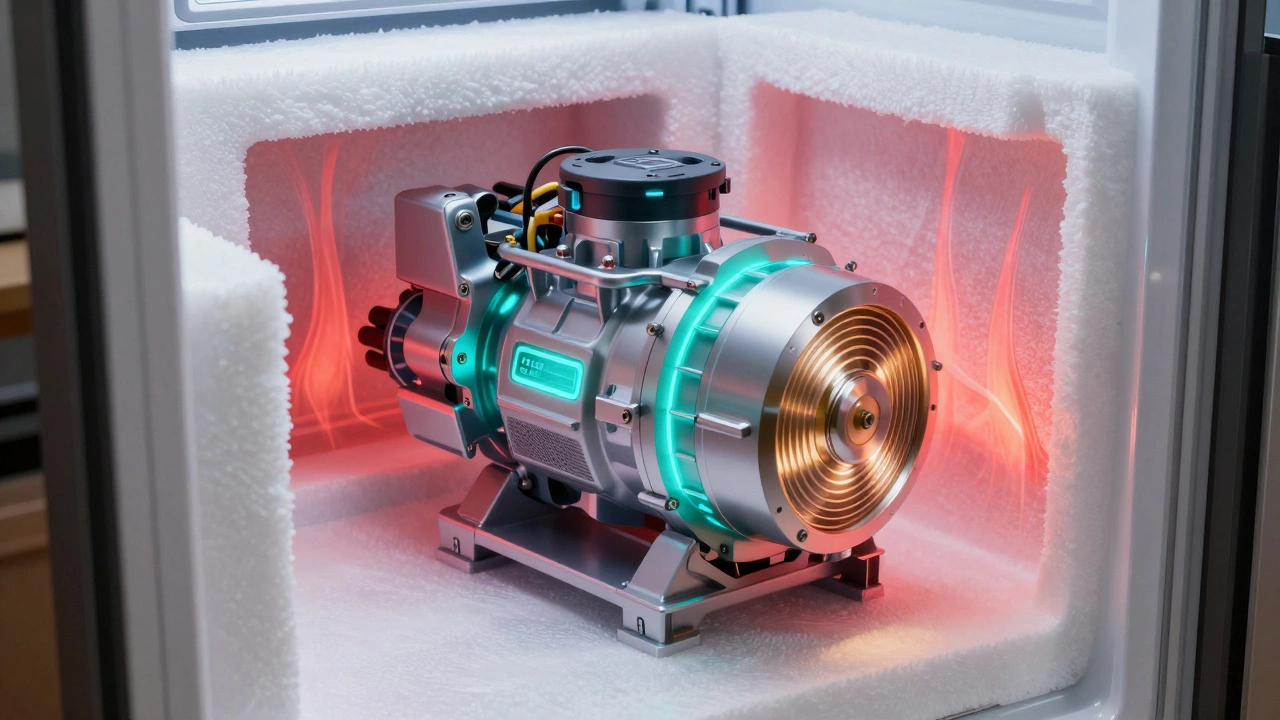
Older fridges used fixed-speed compressors. Think of them like a car engine stuck in first gear. When the temperature rose above the set point, the compressor kicked on at full blast until the interior cooled down, then shut off completely. This constant starting and stopping wasted energy and wore out parts faster. Modern units mostly use inverter compressors variable-speed motors that adjust cooling output based on demand. These run continuously at low speeds, maintaining a steady temperature without the energy spikes of turning on and off. They’re quieter, last longer, and use significantly less power.
Insulation has also improved. Manufacturers now use high-density polyurethane foam with higher R-values (thermal resistance). Some brands even add vacuum-insulated panels (VIPs) in critical areas, similar to the technology used in thermoses. Thicker walls mean less heat transfer from the outside world, so the compressor doesn’t have to work as hard to keep things cold.
Then there’s the issue of lighting. Old fridges used incandescent bulbs that generated heat-essentially working against the cooling system. Every new model uses LED lighting, which produces negligible heat and consumes a fraction of the electricity. While this seems minor, every watt counts when the appliance runs constantly.
The "Feature Tax": Why Bigger Isn't Always Better
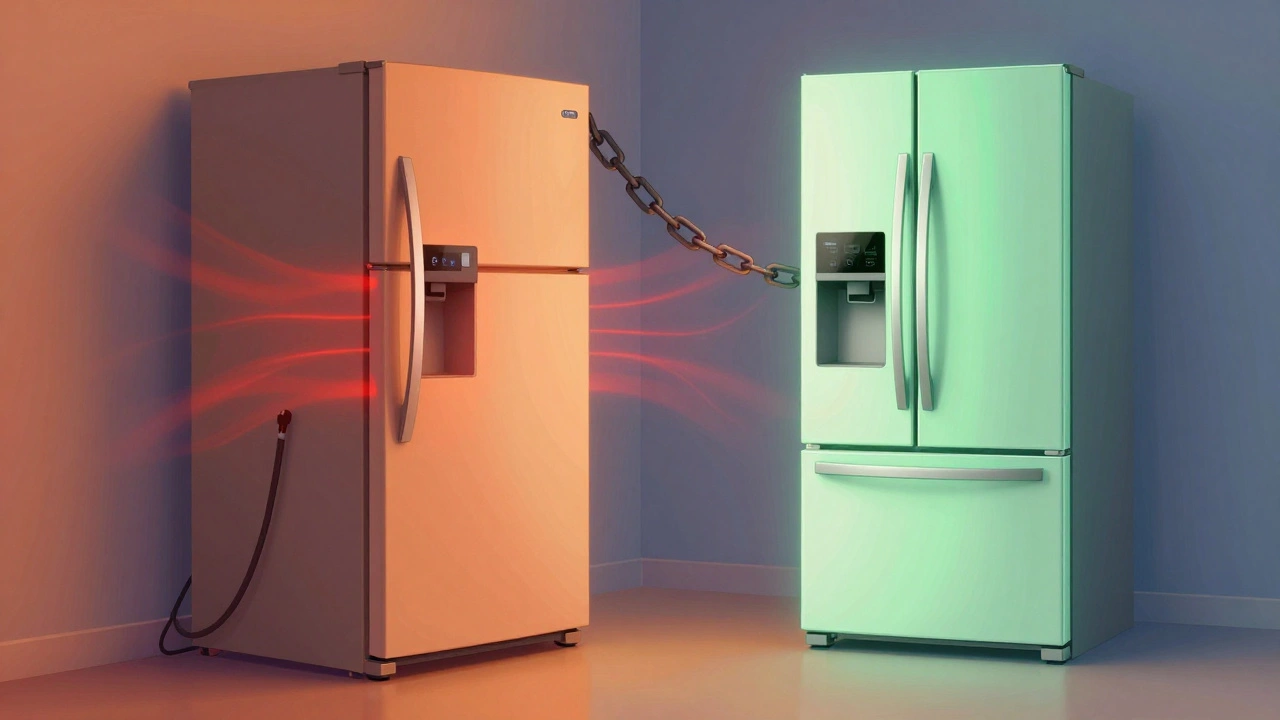
Here’s where the narrative gets tricky. While the *technology* has become more efficient, consumer preferences have shifted toward larger, more convenient appliances. A compact 18-cubic-foot top-freezer model from 2026 is incredibly efficient. But most people don’t want that. They want a 28-cubic-foot French door model with a water dispenser, internal cameras, and Wi-Fi connectivity.
Each added feature comes with an energy cost:
- Through-the-door ice/water dispensers: These require a separate compartment that must be kept frost-free, leading to more frequent defrost cycles and air leaks when the door opens. They can increase energy use by 10-15%.
- Smart features: Wi-Fi modules, touchscreens, and internal cameras draw power even when the fridge is idle. While small individually, they add up.
- Larger capacity: More cubic feet means more air to cool. Doubling the size doesn’t double the energy use, but it certainly increases it substantially.
If you replace a 20-year-old 18-cubic-foot fridge with a new 28-cubic-foot smart model, you might see only a modest drop in energy bills, or none at all. The efficiency gains of the new tech are offset by the increased load of the larger size and extra gadgets. To truly save energy, you need to match the size of the new fridge to your actual needs. Don’t buy space you won’t use.
When Does It Make Financial Sense to Upgrade?
Deciding whether to swap out your current unit requires a quick calculation. Here’s a simple rule of thumb: if your refrigerator is more than 15 years old, it’s likely costing you $50-$100 more per year in electricity than a modern equivalent. Over five years, that’s $250-$500 in savings, which can help offset the cost of a new appliance.
However, if your current fridge is less than 10 years old and working well, the financial return on investment takes longer. A new ENERGY STAR certified model might save you $30-$50 annually compared to a relatively recent older model. At that rate, it could take 10-15 years to recoup the purchase price purely through energy savings. In that case, you’re buying convenience, reliability, and aesthetics-not just lower bills.
Consider the lifespan too. Refrigerators typically last 10-15 years. If yours is nearing the end of that window, replacing it with an efficient model ensures you benefit from the savings for the entire life of the new unit. If it’s halfway through its life, waiting might be smarter unless it’s showing signs of failure.
Maintenance Matters More Than You Think
You can have the most advanced energy-efficient fridge a refrigerator designed to minimize electricity consumption through advanced technology, but poor maintenance will wipe out those gains. A dirty condenser coil forces the compressor to work harder, increasing energy use by up to 25%. Most coils are located behind a kickplate at the bottom or on the back of the unit. Vacuuming them twice a year is a simple task that pays dividends.
Door seals are another hidden culprit. If light sneaks in when the door is closed, warm air is entering, and your fridge is running overtime. Perform the dollar bill test: close the door on a bill. If it slides out easily, your gasket is worn and needs replacement. Proper sealing keeps the cold in and the heat out.
Temperature settings also play a role. The ideal fridge temperature is 37°F (3°C), and the freezer should be 0°F (-18°C). Setting them colder than necessary wastes energy without providing any food safety benefit. Conversely, setting them too warm risks spoilage. Use an independent thermometer to verify accuracy, as built-in dials are often imprecise.
What About Heat Pump Technology?
Looking ahead, the next big leap in efficiency may come from heat pump refrigeration. Traditional vapor-compression systems are reaching their physical limits. Heat pumps, which move heat rather than generating cold directly, can achieve higher coefficients of performance (COP). Several European manufacturers have already introduced prototypes, and by 2026, early commercial models are beginning to appear in premium segments. While currently more expensive, they promise further reductions in energy use, potentially cutting consumption by another 20-30% compared to current best-in-class models.
For now, though, the biggest wins come from choosing the right size, opting for inverter technology, and avoiding unnecessary features. The most efficient fridge isn’t always the one with the lowest kWh rating on the spec sheet-it’s the one that fits your lifestyle without wasting energy on unused space or gimmicks.
How much energy does a typical new refrigerator use in 2026?
A typical new ENERGY STAR certified refrigerator uses between 300 and 450 kWh per year, depending on size and style. Top-freezer models tend to be on the lower end, while large French door models with ice makers can exceed 500 kWh annually.
Is it worth replacing a 10-year-old fridge for energy savings?
Financially, it’s borderline. A 10-year-old model is already somewhat efficient. You might save $30-$50 per year, meaning it would take over a decade to recoup the cost of a new unit. Replace it if it’s failing, or if you want modern features and quiet operation, but don’t expect dramatic bill reductions.
Do smart refrigerators use more electricity?
Yes, slightly. Wi-Fi modules, touchscreens, and internal cameras consume additional power. While the impact is small compared to the compressor, it adds up. If energy savings are your primary goal, stick to basic models without smart features.
Which type of refrigerator is the most energy-efficient?
Top-freezer models are consistently the most energy-efficient due to their simpler design and smaller footprint. Bottom-freezer models are next. Side-by-side and French door models are less efficient, especially if they include through-the-door ice and water dispensers.
How do I know if my current fridge is inefficient?
Check the yellow EnergyGuide label. If it says it uses more than 500 kWh per year and is over 10 years old, it’s likely inefficient by today’s standards. Also, listen for frequent cycling or feel for excessive heat coming from the sides or back, which can indicate struggling components.