
Portable AC True Cooling Power Calculator
Input Specifications
This is the actual cooling power delivered to your room.
Breakdown:
- SAE Inflation Correction: -- BTUs lost due to internal heat generation.
- Hose Penalty: -- BTUs lost due to negative pressure.
- Seal Factor: -- BTUs lost due to air infiltration.
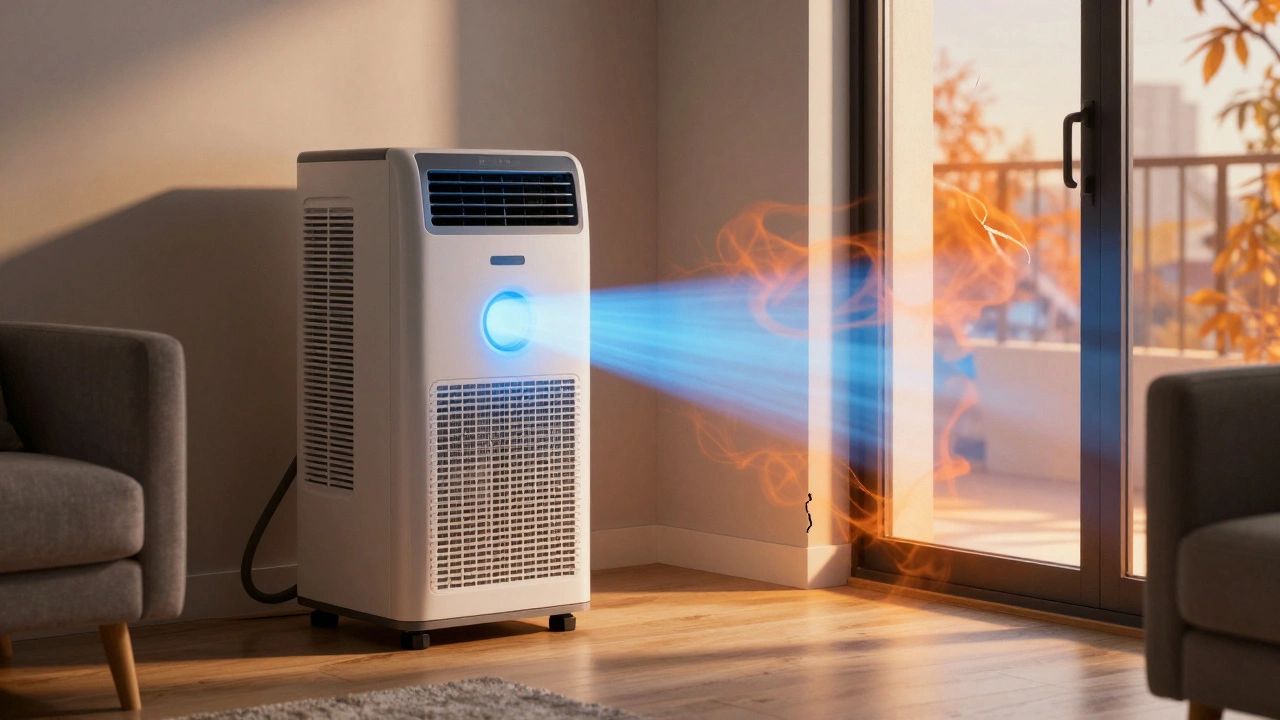
It’s July, the heatwave is hitting Vancouver hard, and you’re sweating through your shirt. You remember that Portable Air Conditioner is a self-contained cooling unit designed to be moved from room to room, offering temporary relief without permanent installation. It sits in the corner of your living room, humming away, but the bill at the end of the month looks like a phone number. Worse, the room barely feels cooler than it did before you turned it on. You aren’t imagining things. Portable ACs are notoriously inefficient compared to their window or split-system cousins. But why? Is it just bad marketing, or is there actual physics working against you?
The short answer is that portable ACs fight a losing battle with thermodynamics and airflow design. They don’t just cool less effectively; they actively work against themselves by sucking hot air back into the room. If you want to understand why your electricity bill spikes while your comfort stays low, we need to look under the hood of these machines.
The Single-Hose Problem: Creating Negative Pressure
The biggest villain in the story of portable AC efficiency is the exhaust hose. Most portable units use a single-hose design. This means one hose connects the indoor unit to the outside world. Its job is to expel the hot air generated by the compressor and condenser coils inside the machine.
Here is where the physics gets tricky. When the AC blows hot air out of that hose, it creates a vacuum effect inside your room. Think of it like sucking a straw-the air leaves, and nature hates a vacuum, so it pulls new air in to fill the space. Where does that replacement air come from? It comes from every crack, gap, and unsealed door in your house. In most homes, this means pulling in hot, humid air from the attic, the garage, or the hallway.
This process creates negative pressure. The AC unit has to work double-time because it isn’t just cooling the air that was already in the room; it’s constantly fighting to cool the fresh hot air being sucked in through the cracks. A study by the University of Michigan found that single-hose portable ACs can lose up to 30% of their cooling capacity due to this infiltration of hot outdoor air. Essentially, you are paying to cool the entire house’s leakage, not just your bedroom.
| Feature | Single-Hose Portable | Double-Hose Portable | Window AC Unit |
|---|---|---|---|
| Airflow Logic | Negative Pressure (Sucks in hot air) | Neutral Pressure (Recirculates indoor air) | Closed Loop (No indoor air loss) |
| Cooling Efficiency | Low (Loses ~30% capacity) | Moderate (Better than single) | High (Maximum efficiency) |
| Installation Ease | Easy (One hole needed) | Moderate (Two holes needed) | Moderate (Window slider required) |
| Noise Level | Loud (Compressor indoors) | Loud (Compressor indoors) | Moderate (Most noise outdoors) |
The BTU Lie: SAE vs. AHAM Ratings
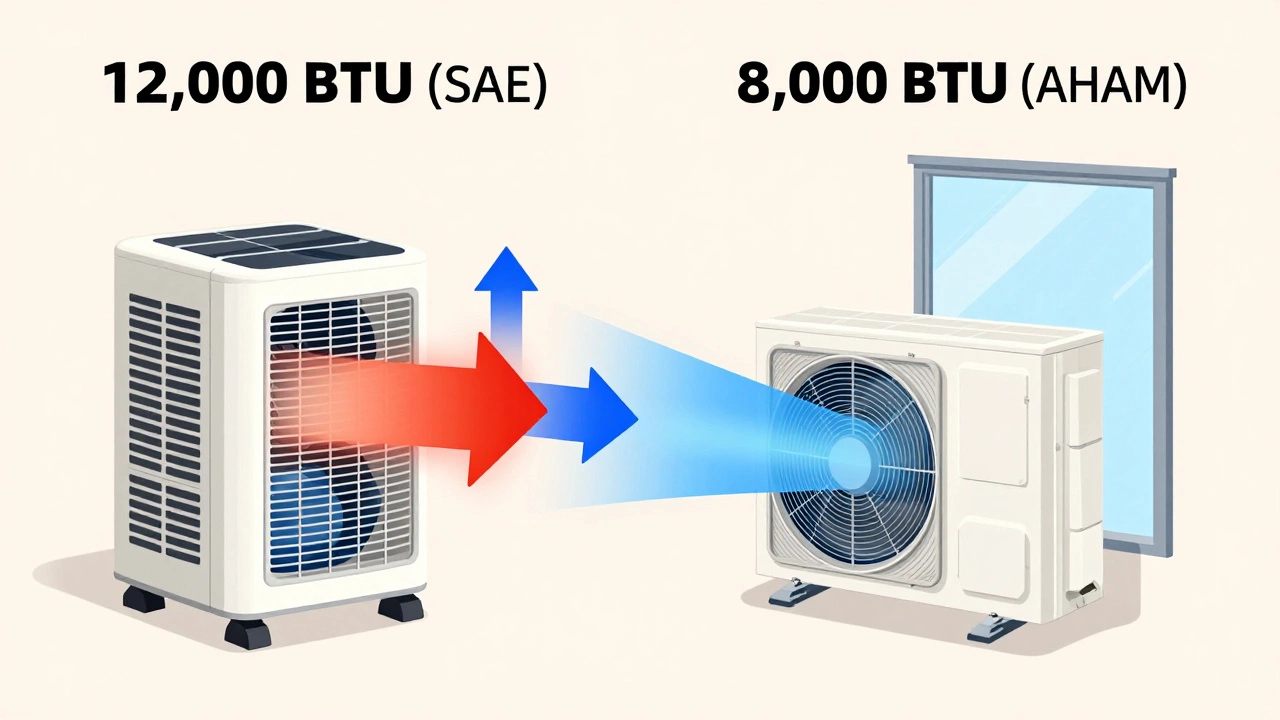
You walk into a store and see two units. One says 12,000 BTUs, the other says 8,000 BTUs. Naturally, you pick the bigger number. But here is the catch: portable AC manufacturers often use outdated SAE (Society of Automotive Engineers) ratings, while window units use modern AHAM (Air-Conditioning, Heating, and Refrigeration Institute) standards.
The SAE rating measures the total heat removed from the air passing over the evaporator coil. It doesn’t account for the heat added back into the room by the compressor and motor running inside the same box. The AHAM standard, introduced in 2016, subtracts that internal heat gain. The result? A portable AC labeled as 12,000 BTUs (SAE) might only deliver about 7,000 to 8,000 BTUs of actual cooling power (AHAM). Meanwhile, a window unit labeled 8,000 BTUs is actually delivering 8,000 BTUs of real cooling.
This discrepancy makes portable ACs look more powerful on paper than they are in practice. When you compare them side-by-side using consistent metrics, the portable unit often falls behind. Always check for the AHAM certification if you want an honest comparison. If the box only lists SAE, assume the real performance is roughly 40% lower than the sticker price suggests.
Heat Rejection Inside the Living Space
In a window air conditioner, the heavy lifting happens outside. The compressor, which generates significant heat, sits in the part of the unit that protrudes into the street. The fan blows that waste heat directly onto your neighbor’s patio. Your indoor space stays cool because the source of the heat is physically separated from you.
With a portable AC, the compressor is right there next to you. Even though the exhaust hose carries away some heat, a lot of thermal energy radiates from the sides and top of the cabinet. If you place the unit too close to a wall or in a tight corner, it traps its own heat. This forces the compressor to work harder to maintain the set temperature, leading to higher energy consumption and shorter component life. It’s like trying to cool down a kitchen by opening the fridge door-the mechanics of cooling generate heat, and in a portable unit, that heat stays in the room.
Condensation Management and Dehumidification Costs
Air conditioning is also dehumidification. To cool air, the unit must remove moisture from it. This water collects in a reservoir inside the machine. Portable ACs handle this in two ways: either you manually empty a bucket, or the unit uses a self-evaporative system.
The self-evaporative system is clever but costly. It sprays the collected water onto the hot condenser coils to turn it into steam, which is then expelled outside via the exhaust hose. This helps carry away more heat, improving efficiency slightly. However, this process requires energy. More importantly, if the humidity is extremely high, the unit can’t evaporate the water fast enough. It stops cooling to focus on draining, or it shuts off entirely to prevent overflow. This intermittent operation reduces the overall comfort level and makes the cooling feel inconsistent compared to a window unit that drains continuously via gravity.
How to Make a Portable AC Work Better
If you are stuck with a portable AC-maybe you rent an apartment where window units are banned-you can mitigate some of these inefficiencies. You can’t change the laws of physics, but you can optimize the environment.
- Seal the Room: Since single-hose units create negative pressure, minimize the gaps where hot air enters. Use weather stripping on doors and windows. The tighter the seal, the less hot air the AC has to fight.
- Use a Double-Hose Kit: Some manufacturers sell conversion kits that add a second intake hose. This allows the unit to pull air from outside for cooling the condenser, rather than sucking air from your room. This eliminates the negative pressure issue and boosts efficiency significantly.
- Position Matters: Place the unit away from walls and curtains. Ensure the exhaust hose is as short and straight as possible. Kinks in the hose restrict airflow, causing the compressor to overheat and cycle off prematurely.
- Block Sunlight: Close blinds and curtains during the day. Reducing the solar heat gain reduces the load on the AC. Every degree of external heat reduction makes the unit’s job easier.
When to Consider Alternatives
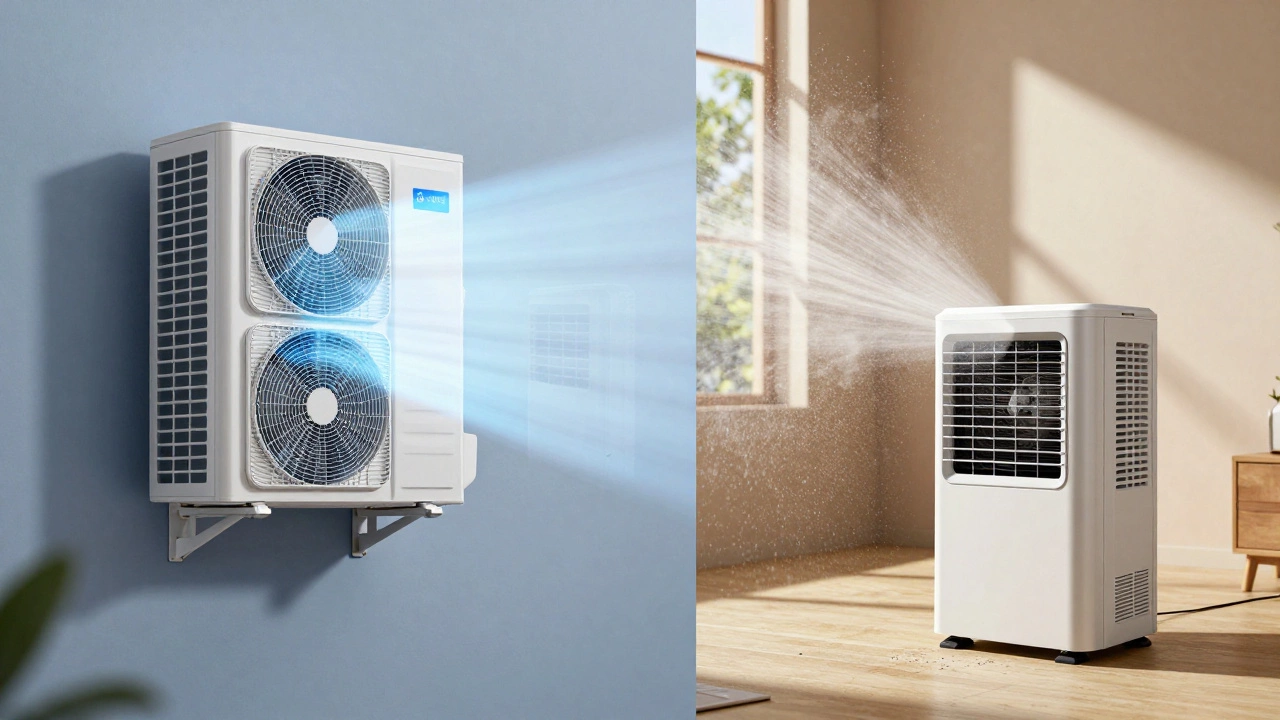
If efficiency is your top priority, a portable AC is rarely the best choice. For renters who can’t install window units, consider a Ductless Mini-Split System is a highly efficient heating and cooling solution consisting of an outdoor compressor and one or more indoor air-handling units. While the upfront cost is higher, mini-splits are 30-50% more efficient than portable ACs. They reject all heat outside and don’t suffer from negative pressure issues. Many landlords now allow mini-splits because they require only a small hole through the wall, similar to a dryer vent.
If budget is tight, a Swamp Cooler is an evaporative cooling device that uses water evaporation to lower air temperature, effective only in dry climates. might be an option if you live in a dry climate like parts of British Columbia or Arizona. They use a fraction of the electricity of compressor-based ACs. However, they add humidity to the air, so they are useless in humid coastal cities like Seattle or Vancouver.
The Verdict on Portable AC Efficiency
Portable air conditioners are convenient, but convenience comes at a premium. Their inefficiency stems from fundamental design flaws: the single-hose negative pressure trap, the misleading BTU ratings, and the internal heat rejection. They are best suited for small, well-sealed rooms where occasional cooling is needed, not for primary cooling in large or leaky spaces.
If you value your electricity bill and your comfort, treat a portable AC as a last resort. Optimize its setup with proper sealing and positioning, or invest in a more efficient alternative like a mini-split. Understanding these limitations helps you make smarter choices when the summer heat rises.
Are double-hose portable ACs worth the extra cost?
Yes, if you cannot install a window unit. Double-hose models eliminate the negative pressure problem by drawing intake air from outside. This results in better cooling performance and lower energy bills compared to single-hose units. They are generally more expensive upfront but offer a better return on investment through efficiency.
Why does my portable AC smell like mold?
Portable ACs often have stagnant water in their condensate trays. If the unit doesn't fully evaporate the water, it becomes a breeding ground for bacteria and mold. Clean the filters regularly and ensure the drainage path is clear. Using the unit in 'dry' mode occasionally can help evaporate residual moisture.
Can I use a portable AC in a large open-plan living area?
Not efficiently. Portable ACs struggle with large volumes of air and open spaces. The cooling effect will be minimal, and the unit will run continuously, consuming excessive power. They are designed for single rooms with closed doors. For open plans, consider ceiling fans or multiple smaller units strategically placed.
What is the difference between SAE and AHAM BTU ratings?
SAE ratings measure total heat removal including heat generated by the compressor itself, inflating the number. AHAM ratings subtract the compressor's heat output, giving the net cooling power delivered to the room. AHAM is the accurate standard for comparing real-world performance.
Do portable ACs work in humid climates?
They do cool, but they may struggle with dehumidification. In high humidity, the self-evaporative system may fail to keep up, leading to frequent drainage alerts or shutdowns. You may need to manually empty the tank more often, which interrupts the cooling cycle.