
Smart Home Health & Risk Checker
Answer these questions about your current setup to identify potential vulnerabilities and reliability issues in your connected home.
Ready to Scan
Check the boxes on the left to assess your home's resilience against fragmentation, security threats, and cloud dependency.
Actionable Recommendations:
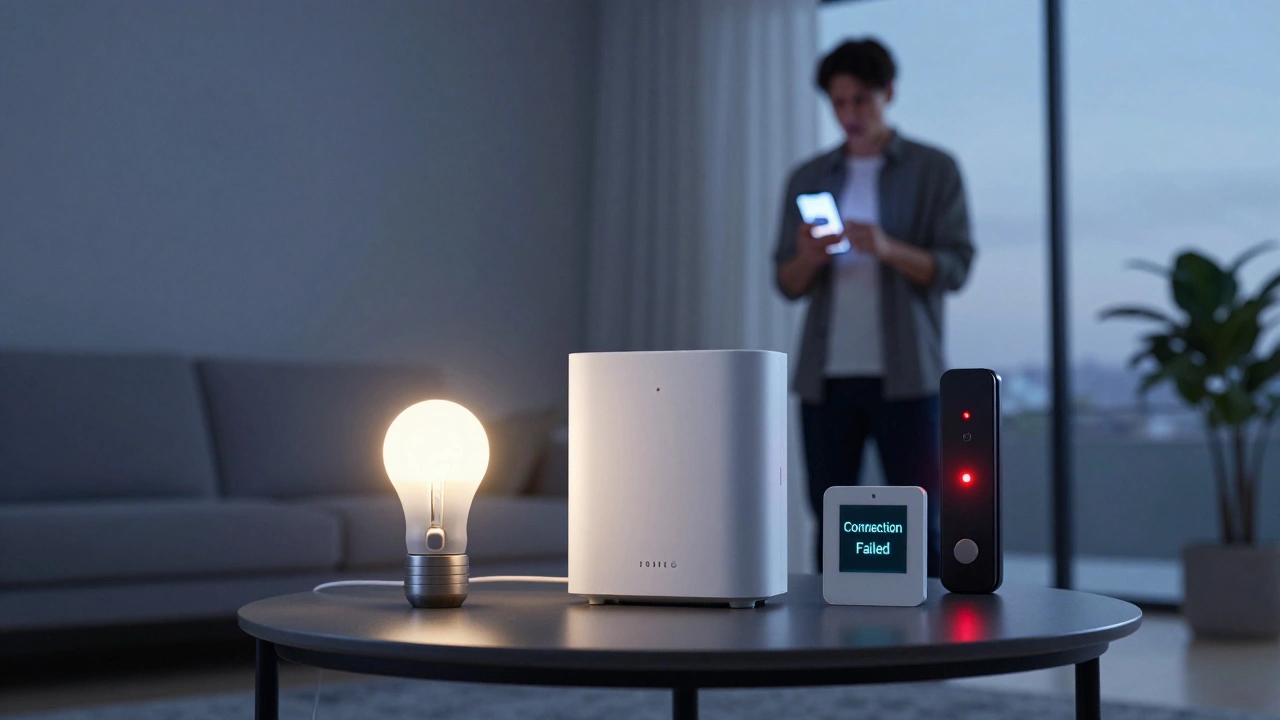
You bought the sleek hub. You installed the sensors. You told your lights to dim when you walk in the door. It worked perfectly for three days. Then the Wi-Fi flickered, the app crashed, and your front door lock decided it was too busy to open. Sound familiar?
The promise of a smart home is a residence equipped with internet-connected devices that allow for remote monitoring and management of appliances and systems. The reality, however, is often a tangled web of proprietary protocols, fragile connections, and creeping anxiety about who is watching.
We are past the novelty phase. In 2026, the question isn't whether smart homes work-they do. The question is why they feel so broken half the time. Let's look at the actual friction points keeping your house from feeling like a sanctuary and more like an IT helpdesk ticket.
The Fragmentation Trap: Why Your Devices Won't Talk
The biggest headache in the modern connected home isn't hacking; it's incompatibility. You might have a thermostat from one brand, cameras from another, and locks from a third. On paper, they should all connect through your central hub or smartphone app. In practice, they speak different languages.
For years, we were stuck with walled gardens. If you bought into the Apple ecosystem, you couldn't easily use certain Google services. If you liked Amazon Alexa, some Philips Hue features felt limited compared to using them directly. This fragmentation forced users to juggle multiple apps just to turn on a light.
Matter is an open-source connectivity standard designed to ensure interoperability between smart home devices regardless of the platform. Launched widely in recent years, Matter aims to fix this by creating a universal language. But here is the catch: adoption is still uneven. Many older devices don't support it. Newer budget devices sometimes skip it to save costs. And even with Matter, setup can be a nightmare if your router doesn't support the required thread border routers properly.
So, you end up with a hybrid system. Some devices talk seamlessly; others require a workaround bridge that sits on your shelf, blinking ominously. This lack of true unity means you are constantly troubleshooting which device is offline rather than enjoying automation.
Security Holes: The Wild West of IoT
Let’s address the elephant in the room: security. When you plug a camera into your network, you are giving it access to your digital life. Most consumers treat these devices like dumb appliances. They aren't. They are computers with microphones, lenses, and network ports.
The problem stems from the business model. Many cheap smart plugs, bulbs, and doorbells are sold at razor-thin margins. Where do manufacturers cut corners? Often, they skip robust encryption, leave default passwords active, or fail to provide long-term firmware updates. A $15 smart bulb shouldn't need a password change every six months, but without those updates, it becomes a backdoor for attackers.
In 2026, we see more sophisticated threats than just random bots scanning for open ports. We see supply chain attacks where vulnerabilities are baked into the hardware before it reaches the store. We see data harvesting where usage patterns-when you leave for work, when you sleep-are aggregated and sold to advertisers or insurance companies.
If you haven't segmented your network, your smart fridge could theoretically talk to your laptop. That is a risk most people ignore until it’s too late. The solution requires technical knowledge that the average homeowner simply doesn't have, creating a massive gap between convenience and safety.
The Reliability Paradox: Cloud Dependency
There is a strange irony in smart homes: they are less reliable than their dumb predecessors. A traditional mechanical switch works forever. A smart switch relies on Wi-Fi, a cloud server, and a stable internet connection.
When your ISP goes down, your lights don't just stay off; they might not respond at all. If the manufacturer’s cloud server crashes (and they do), your entire automation routine halts. You can’t arm your alarm because the app can’t reach the server. You can’t check your baby monitor because the stream is hosted remotely.
This dependency creates fragility. Local control is improving, with more devices offering offline modes, but it is rarely the default. Manufacturers push cloud integration because it allows them to sell subscriptions for video storage or advanced features. But for the user, it means paying monthly fees for functionality that should be inherent to the hardware.
Imagine coming home after a storm. The power is out, the internet is dead, and your smart lock won’t let you in because its battery died during the outage and it needs a cloud handshake to reset. That is the worst-case scenario, but it happens more often than you’d think.
Privacy Erosion: Always Listening, Always Watching
Convenience comes at the cost of privacy. To make voice assistants useful, they must always be listening for wake words. To make cameras helpful, they must record everything. Even motion sensors track your movement patterns throughout the day.
The issue isn't just malicious hackers; it's corporate data practices. Terms of service agreements are lengthy and vague. Users often consent to data sharing without realizing their daily routines are being mapped. Who owns that data? Can you delete it? Is it anonymized, or is it tied directly to your identity?
In many regions, regulations like GDPR in Europe offer some protection, but enforcement is spotty. In other places, there is little oversight. This creates a surveillance capitalism model where your home behavior is the product. Advertisers know what you watch, what you buy, and when you're home. That level of insight is powerful, but it feels invasive.
Many users disable microphones or cover cameras, but then they lose the core functionality they paid for. It’s a lose-lose situation unless you invest in high-end, local-only processing devices, which are expensive and complex to set up.
Complexity and User Fatigue
Setting up a smart home used to be a fun weekend project. Now, it’s a part-time job. Each new device adds configuration steps: pairing, updating firmware, assigning rooms, setting permissions, and testing automations.
When things break-and they will-troubleshooting is frustrating. Is it the device? The app? The Wi-Fi? The hub? The cloud? Error messages are often cryptic. "Connection failed" tells you nothing. You end up restarting routers, resetting devices, and reinstalling apps, wasting hours of your life.
This complexity leads to abandonment. Many people start with excitement but give up when the maintenance burden outweighs the benefits. They revert to manual switches and physical keys, leaving their smart gadgets gathering dust. This churn is bad for sustainability, contributing to e-waste as devices are discarded prematurely.
| Feature | Traditional Home | Smart Home |
|---|---|---|
| Reliability | High (mechanical/electrical) | Variable (depends on network/cloud) |
| Setup Complexity | Low (plug and play) | High (configuration, pairing, updates) |
| Privacy Risk | None (no data collection) | High (continuous data generation) |
| Long-term Cost | Predictable (electricity only) | Unpredictable (subscriptions, replacements) |
| Interoperability | N/A (standalone devices) | Fragmented (requires standards like Matter) |
Environmental Impact and Planned Obsolescence
Smart devices are electronic waste waiting to happen. Batteries degrade. Chips become outdated. Software support ends. A smart thermostat might last five years physically, but if the manufacturer stops updating the app after three, it becomes a brick.
This planned obsolescence is driven by rapid innovation cycles. Consumers feel pressured to upgrade to get the latest features or security patches. Meanwhile, millions of old gadgets end up in landfills, leaching toxic materials. The energy consumption of billions of idle devices also adds up, straining power grids.
Sustainable smart living requires durable, repairable, and updatable hardware. Unfortunately, most manufacturers prioritize sleek design and low upfront costs over longevity. Right-to-repair movements are gaining traction, but progress is slow.
How to Mitigate These Problems
You don't have to abandon smart technology. You just need to approach it strategically. Here are practical steps to reduce frustration:
- Choose Matter-compatible devices: Look for the Matter logo. It ensures broader compatibility and reduces vendor lock-in.
- Segment your network: Use a guest Wi-Fi network or VLAN for IoT devices. This isolates them from your personal computers and phones.
- Prioritize local control: Opt for devices that work offline or via local hubs (like Zigbee or Z-Wave) rather than pure cloud-dependent ones.
- Update regularly: Enable automatic firmware updates. Security patches are critical.
- Read reviews critically: Look for long-term reviews discussing reliability and customer support, not just unboxing excitement.
- Start small: Don't automate everything at once. Add devices gradually and test stability before expanding.
By taking control of your ecosystem, you can enjoy the benefits of convenience without falling victim to the common pitfalls. The goal is a home that serves you, not one that demands constant attention.
Is it safe to have a smart home in 2026?
Yes, but with precautions. Smart homes are generally safe if you choose reputable brands, keep firmware updated, and segment your network. Avoid cheap, no-name devices that lack security updates. The risk lies in negligence, not the technology itself.
Do smart homes really save money?
Potentially, but not automatically. Smart thermostats can reduce heating and cooling costs by optimizing usage. However, the initial investment and potential subscription fees may offset savings. Savings depend heavily on user behavior and existing insulation efficiency.
What happens to my smart home if the internet goes down?
It depends on the device. Cloud-dependent devices will stop working. Devices with local hubs or offline modes may continue basic functions like turning lights on/off via switches. For critical systems like locks, ensure they have manual overrides.
Why are my smart devices incompatible?
Incompatibility arises from different communication protocols (Wi-Fi, Zigbee, Z-Wave, Bluetooth) and proprietary ecosystems. Adopting the Matter standard helps, but legacy devices may never fully integrate. Check compatibility before buying.
Can hackers really access my smart home cameras?
Yes, especially if default passwords are unchanged or firmware is outdated. Hackers can exploit vulnerabilities to view feeds or control devices. Use strong, unique passwords, enable two-factor authentication, and keep devices updated to minimize risk.