
Portable AC Cost & Safety Calculator
Electricity Cost Calculator
Safety Compliance Check
You turn on your portable air conditioner after a long, sweaty day. The room cools fast. You’re tempted to leave it running all night - but should you? It’s a common question, especially in places like Vancouver where summer nights can stay warm and humid. The short answer? Yes, you can leave a portable AC unit on all night - but only if you take the right precautions.
It’s Safe, But Not Always Smart
Modern portable air conditioners are built with safety features. Most have automatic shut-off if they overheat, tip over, or if the water tank fills up. These aren’t just nice-to-haves; they’re required by U.S. and Canadian safety standards. So, technically, leaving one on overnight won’t cause a fire - if the unit is in good condition.
But safety isn’t just about sparks or smoke. It’s about what happens to your body, your wallet, and your home over time. Running a portable AC all night isn’t just about whether it’s possible - it’s about whether it’s the best choice.
How Much Electricity Does It Really Use?
Portable ACs aren’t known for being energy-efficient. A typical unit draws between 800 and 1,400 watts. That’s about the same as a space heater. If you run it for 8 hours straight, you’re using 6.4 to 11.2 kilowatt-hours (kWh) in one night.
In British Columbia, electricity costs around $0.12 per kWh. That means one night of cooling could cost you between 75 cents and $1.35. Sounds small? Multiply that by 30 days - you’re looking at $22 to $40 just for overnight cooling. That’s more than some people pay for a whole month of central AC.
And here’s the catch: portable ACs lose efficiency fast. They’re not sealed like window units. Even the best models leak warm air back into the room through the exhaust hose. That means the unit has to work harder, longer, and use more power just to keep up.
Humidity and Mold: The Silent Problem
Portable ACs remove moisture from the air - that’s how they cool. But unlike central systems, they don’t drain automatically. Most have a tank that needs emptying every 8-12 hours. If you leave it running all night and forget to empty it, the unit shuts off. That’s good. But if you don’t notice it shut off? The room starts getting humid again.
And humidity? That’s where mold grows. In a closed bedroom with no ventilation, moisture builds up on walls, windows, and bedding. A 2024 study from the University of British Columbia found that homes using portable ACs overnight without proper drainage had 37% higher mold spore counts in bedrooms compared to homes using fans or window units.
It’s not just about allergies. Mold can damage drywall, peels paint, and ruins furniture over time. If you’re running a portable AC all night, you’re not just cooling - you’re creating a moisture trap.
What About Noise? Can You Sleep?
Most portable ACs run between 50 and 60 decibels - like a quiet conversation or a refrigerator humming. But some older models hit 70 dB - loud enough to disrupt deep sleep.
People don’t always realize how sensitive they are to low-frequency noise. Even if you don’t wake up, your body might. A 2023 sleep study from Toronto’s Centre for Sleep Medicine found that participants exposed to constant AC noise for five nights had 22% less REM sleep - the stage where your brain processes emotions and memories.
Try this: If you’re using a portable AC at night, put it on the lowest fan setting. Use a white noise app or fan to mask the hum. Better yet, move the unit away from your bed. Distance cuts noise by half.
When It Makes Sense to Leave It On
There are times when running a portable AC all night is the smartest move:
- You have a medical condition - like asthma or heat sensitivity - and your doctor recommends consistent cooling.
- You live in a heatwave and have no other cooling options.
- Your unit has auto-drain and smart sensors (more on that below).
For example, models like the DeLonghi Pinguino a portable air conditioner with built-in auto-evaporation and Wi-Fi controls can drain moisture without a tank. That means no shut-offs, no manual emptying. If you’ve got one of these, leaving it on overnight becomes a lot more practical.
What to Avoid
Here’s what most people do wrong:
- Leaving the unit in direct sunlight - it makes the compressor work harder.
- Blocking the exhaust hose - even a slight kink cuts efficiency by 40%.
- Using an extension cord - portable ACs need a direct outlet. Extension cords overheat.
- Running it on high all night - start on medium, then drop to low after the room cools.
Also, don’t assume a timer will save you. Most portable ACs have timers, but they don’t adjust temperature. They just turn off. That means your room might get warm again before you wake up.
Smart Alternatives
If you’re worried about cost, noise, or humidity, try this instead:
- Use a dehumidifier a device that removes moisture from air without cooling in the evening. It’s quieter, cheaper, and reduces mold risk.
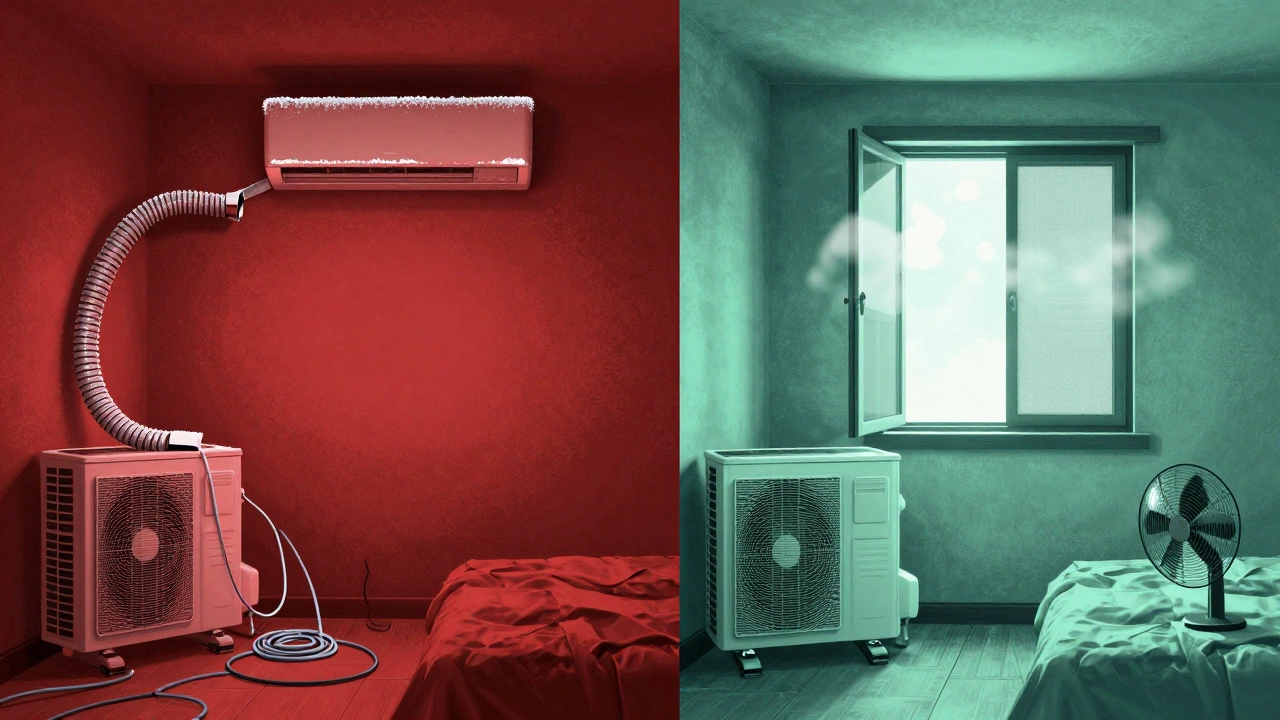
- Pair your portable AC with a ceiling fan a device that circulates air to enhance cooling. The fan lets you set the AC 2-3 degrees higher without losing comfort.
- Open windows at night if the outdoor temp drops below 20°C - which it often does in Vancouver. Use a mesh screen to keep bugs out.
One Vancouver homeowner I spoke to switched from running her portable AC all night to using a fan and opening windows after 10 p.m. Her electricity bill dropped 30% in two months. She also stopped waking up with a stuffy nose.
Checklist: Safe Overnight Use
If you decide to leave your portable AC on overnight, follow this:
- Empty the water tank before bed - or confirm it has auto-drain.
- Ensure the exhaust hose is straight, not kinked, and sealed to the window kit.
- Plug directly into a wall outlet - no extension cords.
- Set the temperature to 24°C or higher - cooler isn’t better for sleep.
- Use a timer to turn it off 2 hours before you wake up.
- Check the unit in the morning - no leaks, no odd smells, no frost on the coils.
Final Verdict
Can you leave a portable AC on all night? Yes. Should you? Only if you’ve checked the box on safety, efficiency, and comfort. For most people, it’s better to use it to cool the room before bed, then switch to a fan or open window. It’s cheaper, quieter, and healthier.
Portable ACs are great for short-term relief. But they’re not designed to be your all-night solution. Think of them like a temporary fix - not a permanent one.
Is it dangerous to leave a portable AC on all night?
Not if the unit is in good condition and you follow basic safety rules. Modern portable ACs have automatic shut-offs for overheating, tipping, and full water tanks. But leaving it on without checking the drainage or blocking airflow can lead to inefficiency, mold, or even damage to the unit. Always read your manual.
Will running a portable AC all night raise my electricity bill?
Yes, significantly. A typical portable AC uses 800-1,400 watts. Running it for 8 hours costs between 75 cents and $1.35 per night - that’s $22-$40 a month. That’s more than running a window unit or using a fan. If you’re on a budget, use the AC to cool the room before bed, then switch to a ceiling fan.
Can a portable AC cause mold in my bedroom?
Absolutely - if you don’t empty the water tank or if the unit shuts off and restarts repeatedly. Moisture builds up on walls and windows when humidity isn’t properly removed. A 2024 study in British Columbia found mold spore levels rose 37% in rooms where portable ACs were used overnight without auto-drain. Always empty the tank before bed or choose a model with auto-evaporation.
What’s the best temperature to set my portable AC for overnight use?
Set it between 24°C and 26°C. That’s the sweet spot for sleep. Cooler than 22°C can disrupt your body’s natural cooling cycle and lead to restless sleep. Many people think colder is better, but your body naturally lowers its temperature at night. A slightly warm room helps you fall and stay asleep.
Do I need to unplug the portable AC when I’m not using it?
It’s not required, but it’s smart. Even when turned off, many portable ACs draw a small amount of standby power - called "vampire energy." Unplugging it when not in use saves a few dollars a year and reduces fire risk. If you use a timer, you can leave it plugged in - just make sure it turns off automatically.